Thursday, August 14, 2008

Authenticity

My dear friend Andy over at Culturebot had some questions the other day that I've been mulling (who can resist a post entitled " a few random, possibly offensive, thoughts and observations"?) I'll want to play with a couple of them, but today I'm focusing on his consideration of authenticity.

My other possibly offensive thought is about culture and authenticity. I was thinking a lot about Hasidism, as I have family members who are pretty much a part of that whole scene. For those of you who don’t know, Hasidism is a version of Judaism espoused by a mystic and scholar known as the Ba’al Shem Tov, beginning around 1734. If you hang in Williamsburg and other parts of the Five Boroughs you’ll see them walking around with the black hats and payot, long coats, etc. The reason they dress that way is that they are dressing, as much as possible, as did the Jews of Eastern Europe during the time of the Ba’al Shem Tov. At least that’s what I’m told. And they basically assert that their form of Judaism is the only authentic form. Which is their right. BUT I was thinking - what if there was some radical sect of African-Americans who dressed in ragged clothes and chains, as did their ancestors in the 18th and 19th centuries, and insisted that they were the only authentic expression of Af-Am identity? You’d think they were friggin’ nuts, right?

So what’s up with that? Does doing things the way they’ve always been done necessarily confer authenticity? How and when did the notion of cultural authenticity even come into existence? I would really, really appreciate it if someone smarter and more knowledgeable than me could explain when culture became so inauthentic and manufactured that we had to draw a distinction?
Sociologists, of course, will say that authenticity as a category is always constructed. This is what cultures do, decide what is genuine and acceptable and what is not. But the question is more interesting than that.

We have senior theses written often asking this exact question and it often comes from students who are deeply enmeshed in popular music and coming out of a suburban middle class background. Are those coming late to the party, only once it has become fashionable, less authentic than those of us who have been involved in the trend before it became well-known and respectable, back when we were marginalized for it? Can I be authentic in producing music that I love, but which began with a marginalized group I do not belong to? Is culture owned?

The entire question of authenticity seems to rely on a touchstone, what philosophers call an ostensive definition, that is when you define a concept by pointing at something and saying what I mean by X is that thing right there and all others appropriately like it. Yes, what counts as appropriate for the similarity relation is a problem, but the part that strikes me interesting in this case is the thing pointed to.

Often, it is not a real thing, but an idealization. We select an artificial construction, often a romanticized image and freeze it, making it into an icon. That icon that never actually existed then becomes the touchstone for genuineness. For Hasidim it is an icon of an 18th century Eastern European Jew. For the Amish, a Christian of roughly the same period. For blues aficionados, it is an African-American musician of the Mississippi Delta from the Depression.

This is not always problematic. Often times, cultural movements do come out of particular places at particular times. Reggae did come out of Jamaica in the 60s from a community of artists intentionally bringing it out of the artistic, religious, and political context. It was designed as an outlet to express the anger, joy, and aspirations of those experiencing that sort of life. There does seem to be some sense in which we can look at the work of the Perry, Marley, and Cliff and say that it is authentic as a touchstone. One could say of those who mimicked the style without the cultural context, that there is something inauthentic, that it is missing a piece. An upper class white kid could love the music, but could never come from the experiences that produced it, no matter how skilled he was at reproducing the sound.

Yet, this denies that every human endeavor, even authentic ones, evolve. Our notion of authenticity is such that it is so deeply committed to its ostensively defined model that it disallows growth, change, and improvement. The model is held up as an archetype, a perfect unalterable Platonic Form, and so authenticity forces us to be stuck in time, a time other than our own, making true authenticity impossible to achieve. Our attempts to be authentic are self-refuting, doomed to fail.

Authentic forms can become influences on others in different contexts and rightfully create new experiences that are themselves authentic. The rich white kid who loves reggae can use that love and the insight in the original to create his own authentic expression of alienation, of being trapped in his own quite different social hierarchy. Non-Hasidim can take from the preserved vision of the Shtetle occupant something that can by contrast or similarity speak truth about life now and about the potential we have to live in a way that better engenders our care for the other.

By binding authenticity to a dead image, often one that never existed, we seem to disallow for authenticity which is the genuine consideration of the actual context of our lived lives. Anyone who has ever kept a journal knows how much of our own lives we forget, how much wealth of experience is lost in day to day living. It is exponentially so with the cultural wisdom we lose when we lose generations. The Hasidic and Amish approaches do remind us that there are questions to be asked about whether this change is a good one, not all change is progress. But, at the same time, some change is good.

In this way, perhaps the notion of authenticity should be replaced with Aristotle's notion of virtue, that which helps us as individuals and as a group make real our potential. We forget some of the ways of those who came before, ways that are helpful in a deeper sense. We too often and wrongly jettison them for something novel. But, of course, those ways can be improved upon and we need the freedom to experiment with the new, knowing that experiments often fail, but not living in such fear of the failures that we fail to try.

Tuesday, August 12, 2008

Bullshit or Not: Mukasey Edition

There's an old sketch film called Amazon Women on the Moon and one of the bits is a parody of the old Leonard Nimoy show, "In Search Of..." called, "Bullshit or Not?" with the tagline "Bullshit or not? You decide." It's a line I like so much that I've stolen it for an irregular series of posts.

This week's comes from Attorney General Michael Mukasey's appearance before the annual meeting of the American Bar Association. In explaining why those who "who took part in or failed to stop illegal hiring practices during the tenure of his predecessor, Alberto Gonzales" would not face any legal ramifications, he said,

"not every wrong, or even every violation of the law, is a crime. In this instance, the two joint reports found only violations of the civil service laws."
O.k., so is there a difference between committing a crime and breaking a law? Surely, there's a difference between a law, a rule, and a policy, but is something like that operative in this case that makes these transgressions non-criminal?

So, bullshit or not? As usual, feel free to leave responses from a single word to a dissertation.

Monday, August 11, 2008

Drill Here, Drill Now: Return of Cage and Frame

As if we didn't know it would return. The rhetorical trick called "cage and frame" is used when a politician has an entire subject he wants to keep from discussing, hiding it safely out of view in a rhetorical cage.

Candidates usually take their cue from magicians by employing a tactic of misdirection – hey, look over there, it’s someone burning a flag while taking the Ten Commandments from a courthouse. This move, what logicians call a “red herring,” is generally effective. But if the topic is urgent, a more sophisticated bit of sophistry is required.

The cage and frame stratagem is to open the cage just enough to let out one token part of the issue in order to make it appear that the topic as a whole is being fairly discussed. The key is to select the tiny corner of the complex concern most easily framed to your advantage, and then discuss it, and it alone, as vociferously as possible. Your opponent now faces a dilemma. If he chooses not to give a full-throated rebuttal, the lack of passion validates the charge in the mind of the public, think John Kerry and the Swift Boat attacks.

Alternatively, you could take the bait, engaging the issue forcefully. The respondent now sounds defensive while arguing from the opponent’s preferred conceptual framework and phrasing. But more importantly, the engagement directs all attention away from the crucial parts of the topic that remain locked away in the cage. The spirited debate concerning this side issue leads the broader public to wrongly infer that they are hearing an open debate about the matter as a whole. If this one issue was not the most important aspect of the question, they reason, why would both sides spend such time and energy arguing so vehemently? In the zero sum game of political coverage, the important elements of the topic will be ignored, exactly as desired.

In the face of spiking gas prices, energy policy affects voters personally, as well as the larger economy and national security. The conversation surrounding this multifaceted subject now includes only the expansion of drilling rights. Further exploration would not bring a single drop of oil to market for several years, making it irrelevant to the current concerns, but never mind because the larger debate about energy independence is off the table. Wind? Nuclear? Conservation? Global Warming? Cap and trade? Gone – successfully trapped in the rhetorical cage once everyone is laser focused on off-shore drilling. "Drill here! drill now!" Cage the energy debate here! Frame it now!

Similarly, with the hand wringing over whether Dems, particularly Obama, will admit that the surge has worked. By making this the sole issue of discussion in foreign policy, everything else – judgments concerning the threat from a pre-war Iraq, the prosecution of the wars, the abandonment of Afghanistan and what to do now in Iraq, Iran, the West Bank and Gaza, North Korea – has vanished without a trace into the rhetorical cage because of a non-issue in a partisan frame.

We are played like rubes in a game of rhetorical three-card monty. The dealer knows where the real debate is, but no matter how we try to follow the cards, we are always shown something else. In this very important election year, we need to unlock the cage for a truly open political debate. We need all of the cards on the table.

Saturday, August 09, 2008

Olympic Pun-Off

Brothers, Sisters, and Transgendered Comedists Everywhere,

In honor of the opening of the summer Olympiad, we get in the spirit with our own competition. It is the Olympic pun-off. Worst sporting pun get Oy-limpic gold.

My entries:

Have you heard of the new Spanish sport that involves eating twenty-six bowls of custard. It's called the maraflan.

There's a new winter sport that combines hockey and the luge. It's called hock a lugie.

Top that, my friends.

Live, love, and laugh,

Irreverend Steve

Friday, August 08, 2008

What Do the Olympics Mean?

In ancient Greece, wars would stop for the Olympic games. It was not merely a time out for recreation, but rather an opportunity for humans to honor the gods by achieving acts of human excellence. It was an arena for human transcendence, to offer up to the gods of Olympus people who in body best modeled them.

The modern Olympics began with a more secular hope, to provide a forum for the world to come together peacefully in the mutual enjoyment of universal sport. It a chance for us to set aside all that we claim makes us different and come together as a human family for something less serious, something humane.

Of course, that didn't last long. Between Hitler's display in the Berlin games of 1936 to the assassination of Israeli athletes in Munich in 1972 to the US boycott of the 1980 summer games in Moscow to the tit for tat Soviet boycott of the 1984 summer games in Los Angeles, the Olympics have gone from a time to join the world to one that reinforces political pettiness and divisiveness. Nations train their athletes to compete as if winning actually meant something for the worth of the nation.

Following a loss to the Soviets in 1988 in which clock management made tenths of seconds fail to exist on the court, the Americans decided that the Olympics would no longer be the purview of amateur athletics and the Dream Team (c) concept was born to the great delight of the corporate sponsors (read: owners) of the games. I will admit that the first team, the chance to bring Bird, Johnson, Jordan, Barkley, Robinson, Drexler, and crew together to make a real team not just a goof-off all-star team was an exciting prospect, but in the end it has made the games into something less than they were or at least appeared to be.

And now, I greet the games with a shrug and a so what. Doped up track stars, spoiled pro hoopsters, fourteen year old gymnasts who have never had a chance to live a real life as a kid, and a network that spends 49% of the time showing commercials, 49% of the time with contrived, sappy stories to make these games into compelling human dramas, and 2% actually showing athletes during which time we have to listen to obnoxious homer announcers...Who cares? The mindless nationalism, especially when the people representing your nation are not the ones you want your kids to see as role models, you know, what's the point?

What do the Olympics mean anymore other than an opportunity to sell me Coke?

Thursday, August 07, 2008

What Aren't We Talking About?

What are the most important issues that are not making it into the Presidential election discourse at this point? What are the candidates and the media not discussing yet that most needs to be? What aren't we talking about that should be talked about?

Wednesday, August 06, 2008

Creativity and the Aging Mind

It is a truism in the world of mathematics that the great mathematicians have done all their best work before the age of thirty. In other fields may be a bit later, but generally when you find revolutionary thinkers, their great work is done early in their career.

As someone who just turned 40, it's got me thinking. If this is true, why?

Seems like there are several possible explanations:

(1) Biology 1 (body focused) -- Great advances take incredible energy and stamina and this is something one has when younger, but loses as one gets older.

(2) Biology 2 (brain focused) -- There are biological changes within the aging brain that makes it less flexible and therefore less likely to display the creativity needed to make new advances.

(3) Advantageous Immaturity -- Great advances take minds uncluttered by a deep understanding of the accepted paradigm, understanding that comes with age and depth of study. Over time, we come to realize that things are not as clean cut as we first think. Progress comes from naively rejecting paths that have been fruitful in the past in favor of new paths that may or may not be. Sometimes these youthful sprints into the unknown lead to new and beautiful meadows, but as one ages, one matures and learns to appreciate what the different paths have to offer. Smelling the roses on the paths already traveled doesn't blaze new ones.

(4) Psychology -- We naturally resist change. When young, everything is new so progress along pathways not previously thought of is easy, but when older we do not want what is familiar and comfortable taken from us and this hampers intellectual advancement.

(5) Sociology -- When young, we have nothing but our work to tie us down, but as we get older, we accumulate commitments to family, to institutions, and to community. We are spread thinner and therefore cannot, indeed do not want to, give the work the undivided attention of our younger selves, undivided attention that is needed for advancement.

(6) Economics 1 -- When younger, we have little stake in the current best theory and every incentive to overthrow it. When older, our earlier successes are the key to recognition and come to define us professionally. Instead of trying to overthrow our earlier work, we try to extend it -- and thereby our status -- making it unlikely that we will willingly surrender what makes us important, the old work.

(7) Economics 2 -- As one gets older, one figures out how to play the game successfully and thereby becomes part of the ossified institution and entrenched in its reward structure. The motivation is thereby to protect the status quo since it is the source of one's status.

(8) Altruism -- Older thinkers see the new pathways perfectly well, but like parents hiding easter eggs, they pretend it was the Easter Bunny just to see the faces of the youngster when they discover them.

So, which of these if any are the operative factors? The main ones? Others?

Tuesday, August 05, 2008

Anthrax Conspiracy

Been thinking a lot about the anthrax issues. I was always shocked at how quickly the issue was ushered out of the public eye. Here were attempts to murder Democratic Senators in a closely divided Senate, something not far off from a coup d'etat, and yet it just seemed to vanish from the news.

I live just a few miles from Fort Detrick and so the idea that it might have been an inside job by one of my neighbors was both frightening and on some level not terribly surprising. While Maryland is a liberal state in large, parts of Frederick county (Fredneck county, as it is widely called) can be scary. From the John Birch Society billboard on route 15 to the klan in Thurmont to the reactionary op/eds in the Frederick "News"-Post, the area is home to some of the most radical of the radical right.

But since the suicide of the latest prime suspect, Bruce Ivins, a rabid right-wing specialist in bioweapons at Detrick, questions and conspiracy theories have been flying. Was it initiated by the Bush administration as an attemot to lure us into invading Iraq? Remember that initially the news reports definitively linked the substance to Sadam Hussein's weapons of mass destruction capabilities because of the presence of bentonite, a fingerprint that proved it was from Iraq...except that there actually was no bentonite found in the sample. Glenn Greenwald points out that ABC News had this "fact" from four independent government sources. Why would these government sources mislead the public in thinking that American made bioweapons deployed against Democrats really came from a country that they had clear intentions on invading? Why hasn't ABC outed these "sources" who lied to them? Why was the FBI so slow to make progress on this case? Did the fact that the terrorist was an American conservative play a role in slowing down the investigation or even keeping the investigation from actually proceeding? Why weren't more resources dedicated? Why are they being so quick to dismantle the investigation?

Were they right about Ivins being a lone gunman ("envelopeman" just doesn't sound omninous enough here, does it?)? The conspircacy theories on this point are not just coming from the left. In the Wall Street Journal, an op/ed contends that Ivins could not have been the source of the poisoned letters.

The principle of parsimony argues that one should look for the simplest explanation. We should always hesitate to consider something the result of a brilliant ploy whenever it is possible to attribute it to banal incompetance. The X Files is fiction. At the same time, we do have an administration that reintroduced and has actively supported the use of black propoganda and covert actions. Of course, this is also a government that has been incompetant at carrying out virtually all functions from protecting American cities to rebuilding Iraq to prosecuting terrorism suspects.

Was the whole thing a government sponsored plot to lure us into an invasion of Iraq and possibly get rid of a couple political opponents? Was the investigation a sham and a cover-up to protect the operation? Is the media complicit? Did Bruce Ivins commit suicide? Was he involed and if so did he work alone? What does a skeptic believe here? Hell, if I know.

Monday, August 04, 2008

Is All Love Sweet?

Today is the anniversary of the birth of Barack Obama and Louis Armstrong (interesting coincidence), but also Percy Shelley.

Shelley wrote

All love is sweet,
Given or returned.
Common as light is love,
And its familiar voice wearies not ever.
They who inspire is most are fortunate,
As I am now: but those who feel it most
Are happier still.
The quotation immediately brings to mind the line from Shadows and Fog,
"There's only one kind of love that lasts - unrequited love. It stays with you for ever."
So, Shelley the romantic or Allen the cynic, who is right? Is all love sweet?

Friday, August 01, 2008

That Joke Is So Old...How Old Is It?

Brothers, Sisters, and Transgendered Comedists Everywhere,

This week good brother Helmut and good brother 71 alerted me to this story.

The world's oldest recorded joke has been traced back to 1900 BC and suggests that toilet humor was as popular with the ancients as it is today.

It is a saying of the Sumerians, who lived in what is now southern Iraq and goes: "Something which has never occurred since time immemorial; a young woman did not fart in her husband's lap."
Yes, friends, a joke so old that John McCain hadn't reached puberty when it was first told.

It's a fart joke and a dirty joke all in one. The Sumerians were truly an advanced civilization, perhaps this is further evidence for Erich von Daniken's claims that the ancient world was visited by aliens because the odds of such primitive cultures having such advanced humorous technology strains credulity.

If that wasn't enough, good brother Bill sent me this review of Jim Holt's new book Stop Me If You've Heard This: A History and Philosophy of Jokes.
In “Stop Me if You’ve Heard This,” his wispy inquiry into the history and philosophy of jokes, Jim Holt offers up a choice one from ancient times. Talkative barber to customer: “How shall I cut your hair?” Customer: “In silence.”
It is wonderful to see the history of humor receiving such play. For too long jokes have been degraded as not being fit for serious discussion because they are not serious. Clearly, an equivocation. Nothing is more human than jokes. Jokes are an anthropological gold mine. Almost nothing tells us more about our ancestors than what made them laugh -- it shows what they took seriously, how they used language, what were the social strata and how easily were they crossed.

Perhaps we are starting into a golden era in Comic Studies. What would be the titles of some scholarly tomes you'd like to see investigated?

"The Sound and the Fury: An Illustrated History of the Whoopie Cushion"
"Laughs in the Time of Cholera: Fake Vomit and its Historical Implications"

Others?

Live, laugh, and love,

Irreverend Steve

Hooters

I don't get Hooters. What are they selling? You look at the name, the way they write the o's, the marketing, and you figure it's about breasts. But in reality, it's just a regular restaurant. A bunch of guys watching NASCAR, eating wings. WINGS! Even when Hooters serves chicken, they don't let you see a breast. So, my sense is that it is a topless bar for people who don't want to go to a bar and don't want to see anyone topless. It's what would happen if Disney decided to open up a strip club -- "You see, it's just like it only with no strippers, making it a wholesome destination for the whole family."

The whole thing seems to be a bit like Confederate Civil War re-enactors. I haven't joined the real Army to go to an actual war in Iraq, but I just want to say I'm a rebel who has sympathy with the non-politically correct side of things...just not that much of a rebel.

Someone please explain Hooters to me.

Thursday, July 31, 2008

Bullshit or Not: Hayek Version

There's an old sketch film called Amazon Women on the Moon and one of the bits is a parody of the old Leonard Nimoy show, "In Search Of..." called, "Bullshit or Not?" with the tagline "Bullshit or not? You decide." It's a line I like so much that I've stolen it for an irregular series of posts.

I've been thinking about Friedrich von Hayek's arguments since reading Cass Sunstein's "Infotopia." Hayek is one of the economic thinkers most associated with modern capitalism. He argues that knowledge is distributed in society, so that markets rather than elite groups of select individuals on central planning committees will be most likely to make most efficient use of that knowledge. Following that line, we have the following quotations:

In a civilized society it is indeed not so much the greater knowledge that the individual can acquire, as the greater benefit he receives from the knowledge posssessed by others, which is the cause of his ability to pursue an infinitely wider range of ends than merely the satisfaction of his most pressing physical needs. Indeed, a 'civilized' individual may be very ignorant, more ignorant than many a savage, and yet greatly benefit from the civilization in which he lives.
and
It is, indeed, part of the liberal attitude to assume that, especially in the economic field, the self-regulating forces of the market will somehow bring about the required adjustments to new conditions, although no one can foretell how they will do this in a particular instance. There is perhaps no single factor contributing so much to people's frequent reluctance to let the market work as their inability to conceive how some necessary balance, between demand and supply, between exports and imports, or the like, will be brought about without deliberate control. The conservative feels safe and content only if he is assured that some higher wisdom watches and supervises change, only if he knows that some authority is is charged with keeping the change 'orderly'.
Note, of course, that the terms "liberal" and "conservative" as Hayek uses them in this second quotation refer to classical liberalism and conservatism and are reversed with respect to our standard contemporary American usage.

So, bullshit or not? As usual, feel free to leave a single word or a dissertation.

Tuesday, July 29, 2008

What Is Peace?

The kids have this little book by Todd Parr called "The Peace Book" and it got me to thinking. Peace is a positive concept, not defined simply as the absence of war. What else, then, is a necessary or sufficient condition for peace? I don't mean peace in terms of quiet or solitude, but as a social/political concept. When we say of a place that it is peaceful or when we say we are working for peace, what is it exactly that we are pointing to?

Monday, July 28, 2008

Best Blog Others May Not Know About

We all have our blogs that we check out regularly -- some are major names, others not so much. What would you recommend that you think more people need to read? Looking for blogs here that are insightful, but underrated (you can include your own if you sincerely believe it to fall in that category).

Saturday, July 26, 2008

The Strawman/Straightman

Brothers, Sisters, and Transgendered Comedists Everywhere,

This week is kvetch-time for Comedists. Sometimes it's just good to get it off your chest, so whatever you have to whine, complain, or rant about, this is it.

Me, I have a comedic bone to pick. There is a rising trend in stand-up that rubs me the absolutely wrong way, a combination of two perfectly legitimate forms of comedy that simply do not work together.

The first is a form of observational comedy that is best described as "don't you hate it when," wherein you take some aspect of life that is annoying and describe it in a way that everyone can identify with and poke fun at it or more likely those who make it so annoying. Think Bill Cosby's dentist sketch. Utter and complete genius.

The second sort of comedy is where you take something normal and blow it out of proportion but keeping it recognizable making it absurd and the more absurd it gets, the funnier. My favorite example of this is Richard Jeni's ode to yeast infection commercials, "A Private Itch/Exploding Scrotum Syndrome." I can't even think of the line "I'll never get that big account now", much less listen to it, without convulsing in laughter. "For God's sake give the man his two dollars."

So, on their own, great stuff. But what has been happening is that they are being combined in an unfortunate way. Many comedians are now taking something mildly annoying, blowing it up to something no one actually does and then using the non-existent annoyance as the hook for a "don't you hate it when" bit. It's using a strawman as a straightman. If it doesn't really exist, people aren't really annoyed by it.

That's not to say that you can't lampoon "don't you hate it" bits. Stephen Wright's line "I hate it when my foot falls asleep because that means it's going to be up all night" is fantastic, but the whole joke hinges on the fact that it is absurd, not that it hides the absurdity, dressing it up as if it were real.

It really pisses me off when the thing blown up out of proportion vilifies or plays on a negative stereotype or bias. I was watching a Larry the Cable Guy routine and he was complaining don't you hate it that you can't walk into a fast food restaurant these days and find a single cashier that speaks English. Um...yes you can. But then you wouldn't be playing working class white Americans against working class Hispanic Americans. You find it in other conservative comedians as well like Jeff Dunham and Jeff Wayne, but it is not just there. It's becoming standard in Chris Rock's writing also. It's laziness and it's an insult to the legacy of folks like Mort Sahl and those who followed. Cut it out and work harder.

There's my rant for the week. So what's got your hackles up?

Live, love, and laugh,

Irreverend Steve

Thursday, July 24, 2008

Nice "Work" If You Can Get It

So, looking at the 2008 White House Office Staff Salary List, there are four "Ethics Advisors":

George, Allison Carr $130,694
Green, Marcella Moira $107,836
Sarkany, Sergio Francisco $86,279
Molinaro, Rachel E $58,206

None of whom seem to have any philosophical background. To be fair, "ethics" in this context generally means avoiding conflicts of interest rather than deliberating about difficult moral conundrums, but still... 130 G's to be an ethics advisor to the White House? There's a job I'd love to have. Reminds me of a comment I heard years ago made about a certain philosopher -- "Having him teach ethics is like having a blind man teach aesthetics."

Get a Job

Playing off of yesterday's post on devil's advocates, let's advocate for the devil. I've always been baffled by the Book of Job. It is bizarre and interesting on so many levels.

It is one of the first places where Satan shows up. He comes off less as God's evil twin than as his enforcer/drinking buddy. They're hanging out in Heaven when God says, "Look at that Job, man, he's one righteous dude." "Nah, he's just been lucky. Bet he'd be like all the rest if he had a tougher lot." "You think Lot was tougher than Job?" "That's not what I'm saying. I mean if you mess with him, he'll turn on you." "Twenty bucks says your wrong." "Give me odds and your on." "Two to one?" "Done."

So, God has Satan kill Job's livestock, destroy his livelihood and then murder his kids. When Job does not curse God, God wins the bet and pays off Job by giving him back everything tenfold. And that's supposed to make everything all better?

First, who bets against God? O.k., the whole omniscience thing is only inserted once the Greek influence kicks in, but still. How could anyone take seriously the idea of picking a different bracket from God in the righteousness version of March Madness?

Second, how do those who buy the omnibenevolence thing make sense of this? He puts out a contract on innocent children. Sure, Job is rewarded tenfold, but then he gets ten new kids for each one who was murdered. What about the original kids? I don't want ten new kids, I want the ones I loved, but you killed them. Who are these kids anyway? They ain't Job's, he didn't make them and if he did, man, would his wife be cursing God. Wouldn't you be completely pissed if you were one of those kids. "Wait a minute. Let me get this straight. You murdered me to win a bet? And now these fake brothers and sisters get to grow up in a life where they are ten times richer and me, I'm here murdered."

Third, when God orders all the nastiness, how does Satan end up with the bad rap when he was just following orders? Is this the theological version of My Lai?

Fourth, what a peculiar sense of justice. If I give you lots more stuff, it's ok to mess with your head, destroy your livelihood, and kill your family. Who looks at the old guys in Trading Places and thinks, "Hey, now there's Godlike behavior. If only more people acted like that."?

Wednesday, July 23, 2008

Devil's Advocate

In the last chapter of Cass Sunstein's wonderful book Infotopia which considers the places where epistemology touches social psychology, he devotes a section to the effectiveness of Devil's Advocates in helping to avoid groupthink in its various forms.

When there is genuine confrontation in a group, what tends to happen is polarization, where participants not only cling to their pre-existing viewpoints, but become more extreme and more confident. We dig in and tend to ridicule, rather than engage our interlocutor out of a sense of being threatened on some level. I've even seen that happen here from time to time, as good as we tend to be as a community about avoiding ad hominem attacks.

But interestingly, when the person we are arguing against is someone we know to be playing Devil's Advocate, the threat diminishes and the discussion actually proceeds at a higher level than when there is a legitimate advocate (as long as the Devil's Advocate puts his/her heart into it, of course). I used a similar method in teaching Contemporary Moral Issues where the papers were to take dialogue form and competing positions had to be worked out in great detail forcing the student to be his/her own Devil's Advocate.

I was talking with Confused, Maybe Not a while back about this idea and I think it is time to implement it. We need a Devil's Advocate here. But not just a given person, rather a given name that anyone can assume who will be universally recognized as the Devil's Advocate. Anytime you see what may be groupthink or poorly defended consensus, feel free to post a comment as the Devil's Advocate. The only rule is that the name cannot be misused -- you must set out the strongest, most thoughtful case against the reigning opinion. You have to really throw yourself into the role in good faith.

Now, what we need is a name. "Devil's Advocate" would be clear to newcomers, but seems far too bland for a playground where nicknames are the norm. "DA" seems not clever enough. The Navajo trickster's name, "Kokopeli," appeals to me, but I'm not sold on it. Other thoughts? We need a good one here, folks.

Tuesday, July 22, 2008

Health and Party: A Study in Common Cause

A new study finds that Americans rank first in the world in terms of money spent on health care and 42nd in the world in terms of life expectancy. Not much of a bargain, huh?

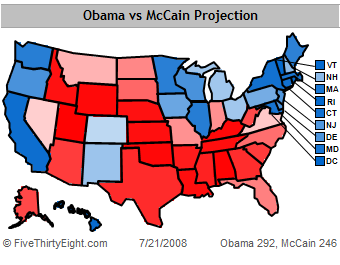
Turns out, though, that there is a wide difference along geographical lines. Different states will have extremely different average life spans. Check out this map. The darker the brown, the longer the average lifespan in the state.

Compare that map to this one:This is Poblano's projection map of the upcoming Presidential election. With the exception of Alaska, all of the states with the longest life expectancy, those with the two darkest shades of brown are likely voting Democratic. All the states with the shortest life expectancy, with the exception of New Mexico, are likely voting Republican.

Quite a striking correlation. Does this mean that Democrats live longer? Does this mean that states with better funded social programs create situations where people have greater lifespans?

As Marty Kaplan points out, it more complicated than that:

How can that be? What could possibly determine whether America is among the industrial world's healthiest nations, if not the thing we're all clamoring for: universal heath insurance? The answer -- and this isn't a political opinion, it's an epidemiological finding -- lies in the social determinants of our physical condition. Determinants like income, class, education, racism, the availability of public transportation, land-use policy, environmental policy, participation in the political process and a host of other factors that don't depend on our genetic makeup or our propensity to take personal responsibility for diet and exercise. Determinants that flow not from luck or individual choices, but from laws, regulations and priorities set at all levels of government and in the private sector as well. (If you want an alarming eyeful about this, check out the new California Newsreel documentary "Unnatural Causes.")

The way we currently think about health in America -- about health care, that is -- is completely understandable. We all want access to the best possible health care for our parents, our kids and ourselves, and we want it to be affordable, and we want plenty of choices. What's astonishing is that even if we covered all the uninsured's health care, we would still likely rank at the bottom of industrial countries for healthiness. The major causes of our country's healthiness or unhealthiness are all upstream of the things that send us to doctors and hospitals and pharmacies. The causes are poverty, and stress, and the amount of control and autonomy we have at our jobs, and whether there are showers there, and what they put in the vending machines. The causes are access to early childhood education, and to day care, and whether schools are built near asthma-breeding freeways. They are whether your neighborhood offers public libraries and public transportation and walking trails, or public dumps and liquor stores and fast food franchises.
Turns out that the idea of health really is more than just bodily functioning, but is a matter of the full lived life.

Why is there a connection between voting patterns and life expectancy? Wealth, education, social infrastructure all play roles. Certainly access to good quality health care is important. A dear friend of mine is a surgeon at Johns Hopkins, the top hospital in the country, which happens to be located -- intentionally -- in a bad section of Baltimore. He tells me how the cases that come in from all over the world are exotic, tricky, the hardest most medically intricate and interesting who are sent to Hopkins. But those who come in through his emergency room are complicated also. Some he has taken bullets out of before, others with substance problems, many with nutritionally connected or tobacco related concerns, medical problems of class and race...and this is in Maryland, one of the dark brown states.

It shows how intricate social problems really are. We can't solve the crisis in health care without tackling the environment and education. The problems in our schools are connected to the problems with nutrition. These are connected to under and unemployment. These are connected to education and health to close the complex circle which closes in on itself in any number of other ways.

It turns out that the body politic is much like the body, the thigh bone is connected to the hip bone, a disease in one part will effect other parts in unexpected ways. Just as our parts are not autonomous atoms, neither are we. The live lived by everyone else does indeed effect the quality AND length of our own.

Sunday, July 20, 2008

Crosswalk Pushbuttons

Do the buttons at intersections really do anything other than give you a sense of agency, that is, the feeling that you have control over something while you are waiting for the light to change as it would anyway?

Friday, July 18, 2008

Passing the Plate: Musician Edition

Brothers, Sisters, and Transgendered Comedists Everywhere,

It is that time again. Other religions ask for monetary donations, but Comedists tithe jokes. This round's theme: music. Pull out your best music jokes and put them in the plate.

Here's a couple to start us off:

I’ve never actually met Ani DeFranco, so, I mean, she might be a really nice person. I’m just saying that if I was hanging out with someone whose first name was the plural of anus, it might make me a little leery.

I went to a great jazz-themed seafood restaurant the other day. The "Fluke Ellington" was very good, but I wasn't about order the "Salmon Ella."

Why did Bach have so many children?
He didn't have a stop on his organ.
So, my fellow Comedists, dig deep and contribute what you can.

Live, love, and laugh,

Irreverend Steve

Foreign Languages

So, last week addressing a meeting of La Raza, Obama argued that we shouldn't worry about immigrants learning English because, like all other immigrants before them, they will. He argued that instead we ought to be worried about the fact that the overwhelming majority of Americans only speak English. Let's put the energy into making sure our children are multilingual.

He argued that it it is embarrassing when Europeans come here speaking English, French, and German when we, in general, only know simple phrases at most. Being bilingual, he argued, helps in getting good jobs and it makes us part of the global community which improves international relations, not to mention that it makes individual life richer.

The xenophobic right-wing has gone bananas over it: see Lou Dobbs and John Derbyshire, because it shows weakness on illegal immigration, everyone else in the world does or should speak English, and Obama's an elitist for thinking that everyone else is smart enough to learn two languages.

We were in Montreal the other day, so this issue really hit home. We like putting the kids in a place where they realize that not everyone speaks like they do, that the world is bigger than they usually see.

But the one objection that is probably worth discussing is Derbyshire's question of aptitude. Neurologically, of course, Derbyshire is full of it. The young human mind is so flexible that it much more easily picks up languages -- it is not some ability limited to liberal intellectual elites. But, given all of the things our schools need to improve upon, given that arts and physical education are being cut back, given that we have biology teachers who are creationists, how high should this be put on the agenda? Would widespread multilingualism really make us more sensitive to the world beyond our borders? Would it really lead to more and better engagement with the world for u individually, for our government and our businesses? Is language acquisition something crucial or is it oversold?

Wednesday, July 16, 2008

How Contextual Is Taste?

There is no doubt that taste is not directly accessed, but is influenced by all sorts of other factors. The question is how sensitive taste really is to that which has nothing to do with chemistry, physics, or biology. My kids, like all kids, insist that aspects of the food that adults deem irrelevant to taste, indeed consider ridiculous, are in fact crucial. Does (or can) a sandwich really taste different if it is cut into two rectangles as opposed to two triangles or four squares? Does the corn on the cob taste different from the same corn off the cob? Isn't this why restaurants garnish meals? How much of taste is a function of chemical reactions on the tongue and how much of it is psychologically constructed?

Monday, July 14, 2008

Is Deliberation Fatally Flawed?

Been reading Cass Sunstein's Infotopia and have been thinking about his argument in chapter 2 where he contends that deliberation as a means of decision-making is deeply flawed.

Philosophers have long held deliberation up as the key to finding truth. The Socratic method, the elenchus, is the template for virtually all philosophical methodology and is based on the idea that two people working off of each other will guide them both to truth. Aristotle, the thinkers of the Enlightenment, and post-Enlightenment figures like Popper and Habermas have placed open and fair competition in the marketplace of ideas as the cornerstone of the edifice of reason, as that which gives us the surest path to knowledge.

The idea is that when the arguments compete, the stronger will survive and unpopular views that turn out to be right will have a fair chance against widely held views that turn out to be wrong. Deliberation allows us to combine our perspectives and ideas into bigger grander visions and to test them stringently against competitors and counter-arguments.

Sunstein argues that when we look at the results of social psychology, the real story is completely different. Deliberation in some cases can be wonderful, but by in large deliberation fails for three reasons:

(1) As Alfred Adler said, "To be a human being means to feel oneself inferior," we are insecure beings and when we hear others, especially a majority of others disagreeing with us, we will tend to silence ourselves thinking that we were wrong or that our view is flawed. As such, minority views are often self-censored out of personal doubt and therefore not pressed allowing flawed majority views to win.

(2) Social norms are enforced. Those with minority views, even if they do not doubt them in the face of competing views, will often self-censor out of fear of reprecussions. Being different has its costs and this often impoverished the deliberative process making it ineffective.

(3) Even if someone has a good argument to support a view, there is not often sufficient motivation to partake in deliberation. You know you are right, why bother fighting the good fight, especially if you have an advantage of some sort by having a truth others don't?

The effect of these factors is that when you look at people's beliefs after a deliberative process, more often than not, what you get is not consensus around a universally acknowledged superior view, but increased polarization. Studies show that those who came in with a liberal leaning will leave with an even more liberal viewpoint and a stronger degree of certainty in it. Similarly, those who were predisposed to a conservative view will have a more hardcore right-wing position with a greater confidence in it. For this reason, he contends that the philosophers' dream of deliberation as a golden road is wrong.

I've been thinking about this a lot. Does it make sense to teach critical thinking as a philosophy class and not couple it with a social psych class?

But more interestingly (at least to me), there seems to be an important disconnect between Sunstein's argument and that of the champions of deliberation. The Enlightenment thinkers pit argument against argument in some sort of metaphorical Darwinian ecosystem. It is the view that wins or loses. But what Sunstein considers is not the abstract argument, but people's own views. The difference is like comparing Plato's idealism in which ideas have an independent existence of their own to Berkeley's idealism in which ideas require a mind to think them. Sunstein reduces the entire process to people's beliefs whereas the classical and Enlightenment views holds that truth is something other than belief.

The question, of course, is what. Sunstein gives us actual, operational, measurable variables. We can ask people what they believe and how much confiedence they have in it. If this is all we have to play with, then perhaps Sunstein is right. But is there more? If so, what?

We can talk about consensus belief. We do this in terms of "the scientific community" all the time. There is a wonderful passage in Aldo Leopold's A Sand County Almanac where he makes the same sort of argument with respect to increasing sphere of moral considerability wherein more and more people became people, animal abuse became seen as morally problematic, and ultimately he argues we will have to consider the land itself in making moral decisions. Here we are talking not about individual beliefs but group beliefs. Could this move restore a long-view faith in the ability of deliberation?

Or do we need some sort of extra-personal status concerning propositions? Martin Luther King, Jr. famously quoted Stephen Oates in saying "The moral arc of the universe is long, but it bends towards justice." This notion requires a metaphysical standpoint, something the Reverend King would not have been bothered by, but surely we don't need a god to have deliberation work as we hope.

Social psychology may have shown us that deliberation is not effective in the short run in terms of making individuals better decision-makers, but what would have to be true to make it effective in the long-run? Do the local failings of deliberation make it a globally flawed process?

Sunday, July 13, 2008

Hair-Trigger Democrats

A couple of jokes have a number of my fellow liberal bloggers in a full snit and I'm not exactly sure why in either case.

First, there is the cover of the latest edition of the New Yorker. Clearly, a bit of satire ribbing the far right wackos trying to paint Obama as Muslim and pro-terrorist. John Avarosis at Americablog sees this as

"A liberal media that bends over so far backwards to be "fair" that it becomes just as bad as FOX News."
He quotes Jake Tapper,
I wonder what the reaction would be were it the Weekly Standard or the National Review putting such an illustration on their covers.

Intent factors into these matters, of course, but no Upper East Side liberal -- no matter how superior they feel their intellect is -- should assume that just because they're mocking such ridiculousness, the illustration won't feed into the same beast in emails and other media. It's a recruitment poster for the right-wing.
It is not merely intent that matters, it is context. This is clear sarcasm. The fact that someone could misconstrue the sarcasm makes it offensive?

Then, there's Bernie Mack appearing at an Obama fund raiser did a ten minute bit that ended with this line:
"My little nephew came to me and he said, 'Uncle, what's the difference between a hypothetical question and a realistic question?' I said, "I don't know, but I said, 'Go upstairs and ask your mother if she'd make love to the mailman for $50,000.'"
Melissa at Shakesville titles her post about it "Unbelievable" labeling the joke misogynistic.

I consider myself somewhat well read in contemporary feminist writing and cannot see where a second or third wave theorist would have a strong argument concerning misogyny here. The second wave writers generally approach such cases by pointing out where speech acts reinforce negative stereotypes making them more deeply embedded in the gender categories we use to make sense of the world. In a patriarchal society, those categories begin in a way that male is equated with the positive and female-related properties have inherently negative connotations.

What is the property here that the joke is supposed to be reinforcing? That women are greedy? That women are promiscuous? That women harbor secret desires to become prostitutes? None of these seem to be parts of the standardly enforced traditional gender roles.

Third wave, sex positive theorists oppose the sociological bent of the second wave arguing that feminist theory needs to respect the autonomy of women in a way that appeals to patriarchal oppression models underestimates. It seems to me that these folks would see the question as one that plays upon exactly that autonomy -- would the women take the question as hypothetical or would she really accept the indecent proposal. That a question that should be purely hypothetical according to white middle class values might actually be taken seriously, that is, that the mother might not see her options limited by traditional socially enforced sexual mores -- an option we didn't expect since we are programmed to operate within that enforced structure -- provides the frame shifting that is necessary for the utterance to be a joke. the idea of freeing ones mind from these strictures would not be seen as offensive on third wave grounds.

It seems a well-crafted joke that sets us up based on social expectations and jars them in a way that titillates. O.k., I'll grant that titillation is probably not the best choice for a political fund-raiser, but that is a matter of poor taste, not misogyny. It seems more a case of working bluer than appropriate, but I'm not sure why the joke is offensive.

Steve Martin famously said, "Comedy isn't pretty." Am I missing something here or have the last eight years, the loss of a female candidate, and the passion of the election season just combined to give some of us far too thin a skin? I remember last election when Whoopi Goldberg made an obvious joke playing off of the last name "Bush," and the right getting themselves worked up into a lather. It was absurd. It was theater, false outrage. Are we finding ourselves in the same place?

Friday, July 11, 2008

Comedist Rituals and One Proud Poppa

Brothers, Sisters, and Transgendered Comedists Everywhere,

So, we took the kids to Pizza Putt, a pizza joint, miniature golf course, and arcade. The shorties played in the arcade for an hour amassing a large number of tickets which could be redeemed for cheap plastic crap made in China. My son took his share of the tickets and in a very decisive fashion declared that he wanted the whoopie cushion.

My son has got first whoopie cushion. They grow up so fast [wiping sentimental tear from eye]. It truly was like a coming of age ritual in a Comedist household (and has the added advantage that I can now blame it on the whoopie cushion whenever I need to).

This made me think that we will actually need rituals marking off the important times of life and the year. For suggestions I turn to you, my friends. What should be the sacred Comedist rites and rituals? Baptism with a squirting lapel flower? Reading from the Friar Club joke book at 13? A roast for a funeral? Suggestions?

Live, laugh, and love,

Irreverend Steve

License Plates

Man, timing is everything. So, one of my favorite things to do on road trips is to look for license plates (40 states and 5 Canadian provinces on this trip, so far).

I had started working on a new bit about license plates (You can tell so much about a state from their license plate, just look at the colors. Deep south states like Alabama, North Carolina, Louisiana, Texas -- all red, white, and blue. Vermont has that beautiful deep green that makes you think you have to pick them up in the parking lot behind the DMV where some guy in a van gives them to you in a rolled up zip lock baggie. New Jersey, yellow, but not just any yellow...the exact shade of urine. They're planning a new tribute plate to Jesse Helms in North Carolina -- all white with eye holes cut out.)

And then YKW sends me a link to a story about South Carolina planning a new Christian license plate (the original CNN story is no longer up.) The plate is being challenged on church/state separation grounds, the argument being that this in some way counts as state advocacy for a given religion. The argument against is that this is a voluntary plate and that acknowledgment is not advocacy. Is there a legal problem here?

YKW thought it would be interesting to also consider other possible statements for SC plates.

Wednesday, July 09, 2008

Memory, Meaning, and Value

A friend was relaying a conversation she had a few years back when her kids were quite young. The family had taken an incredible long-distance trip and a friend remarked to her that it was a waste because the kids were so young they would never remember it.

How important is memory to the value of an experience? We certainly endow remembered events with meanings by creating stories. Some are stories in themselves if they are especially interesting or amusing. Major happenings are woven into complex narratives serving as pivot points, allowing us to use them as explanatory tools in describing who we are and how we got to be where and who we are.

But what of all the moments lost? Are they meaningless? Anyone who has ever kept a journal realizes just how much of our own past fails to survive the editing. We remember so little of what was our own lives. If you know that you would forget something, does that diminish its value in any sense?

Tuesday, July 08, 2008

Bullshit or Not: James A. Michener Edition

There's an old sketch film called Amazon Women on the Moon and one of the bits is a parody of the old Leonard Nimoy show, "In Search Of..." called, "Bullshit or Not?" with the tagline "Bullshit or not? You decide." It's a line I like so much that I've stolen it for an irregular series of posts.

This week's quotation comes from James A. Michener,

The master in the art of living makes little distinction between his work and his play, his labor and his leisure, his mind and his body, his information and his recreation, his love and his religion. He hardly knows which is which. He simply pursues his vision of excellence at whatever he does, leaving others to decide whether he is working or playing. To him he's always doing both.
Voltaire argued in Candide that we needed time in the garden. Michener seems to be arguing that finding the right job is like being a constant gardener. Bullshit or not?

As usual, feel free to leave anything from a one word answer to a dissertation.

Monday, July 07, 2008

How Much Vacation Is the Right Amount?

Travel anywhere and you will find lots of Europeans, especially Germans who get much more vacation than American workers. Two weeks a year certainly does not lend itself to human flourishing. How much vacation would be appropriate? How much time off would be maximally compatible with living fulfilling lives and still being folks committed to our occupations?

Saturday, July 05, 2008

Happy 4th of July Everyone

Brothers, Sisters, and Transgendered Comedists Everywhere,

Leaving for vacation, so a short one for the holiday weekend.Live, love, and laugh,

Irreverend Steve

Friday, July 04, 2008

Best American Corporations

So, we've talked a lot about corporations this week. It's the 4th of July and we're about to head up to the land of Ben and Jerry's. So, who would be on the list of best American corporations and/or companies?

I nominate Dr. Bronners.

Others?

Wednesday, July 02, 2008

Choice Architects, Autonomy, and Responsibility

One of my favorite writers is Cass Sunstein. A brilliant man and a great writer, he's been on a roll the last few years with questions I've been thinking about as well: how do we mesh facts from social psychology -- facts that show how our choices are affected by social pressures, context, and sensory stimulation -- with our notions of rationality and morality that we inherit from the Enlightenment that paint us as intellectual atoms capable of autonomy and objectivity?

I heard an interview with Professor Sunstein and Richard Thaler his co-author and a Prof of Economics and Behavioral Sciences at University of Chicago concerning their book Nudge: Improving Decisions About Health, Wealth, and Happiness In the book, they wrestle with the fact that small things, like the order of names on a ballot, for example, will have an effect on the outcome of an election. As such, we need to be cognizant of "choice architects," the people who set up the way our choices are made and especially those who design the defaults for not making a choice.

This is especially important because social scientists show a strong bias for the status quo, even if that state is harmful. We are wired to be conservative in the sense that the threshold for change is higher than it would be if we were purely rational beings. Human beings are unbelievably plastic entities; we can get used to anything, no matter how irrational, how harmful, or how inconvenient. And we will then defend nearly to the death the old faulty system. It brings to mind the old John Maynard Keynes quip -- when asked how his revolution in macro-economics was coming along, he replied, "We make progress one funeral at a time."

I've marveled at this. Progress in Northern Ireland, for example, was at a standstill until the horrible bombing at Omaugh killed innocent children. Only then were people willing to step back from terribly irrational and harmful stances and adopt a stance of openness and reconciliation. It seems as if the status quo must be knocked from our hands by tragedy if we are to progress at all.

But this reluctance is also contextual. Insecurity often causes us to cling to that we know is wrong when we are afraid of losing our identities, our places, or that which is familiar. There are many stock examples of harmful cultural practices that were being culled from societies until colonizers tried to impose a new way of life. The risk of losing identity caused a resurgence in even the problematic aspects of the culture.

It seems then that social psychology does not, as some post-modernists might argue, show us that rationality ceases to exist, but that contrary to the naive Enlightenment view, it is not necessarily our natural state. Rationality can occur when the factors undermining it are controlled for. But then this requires not only an ability to make decisions well, but also an understanding of those biasing factors and how they affect us.

Given that most people will never be able to acquire such information, then, can we really hold people responsible for irrational choices? Do the choice architects, those people who designed the system, bear responsibility for choices they did not make?

Bullshit or Not: Milton Friedman Edition

In light of yesterday's post, let's play Bullshit or Not.

There's an old sketch film called Amazon Women on the Moon and one of the bits is a parody of the old Leonard Nimoy show, "In Search Of..." called, "Bullshit or Not?" with the tagline "Bullshit or not? You decide." It's a line I like so much that I've stolen it for an irregular series of posts.

Today's extended quotation comes from a famous piece from the New York Times Magazine in 1970 by Milton Friedman entitled "The Social Responsibility of Business Is To Increase Its Profits."

When I hear businessmen speak eloquently about the "social responsibilities of business in a free-enterprise system," I am reminded of the wonderful line about the Frenchman who discovered at the age of 70 that he had been speaking prose all his life. The businessmen believe that they are defending free en­terprise when they declaim that business is not concerned "merely" with profit but also with promoting desirable "social" ends; that business has a "social conscience" and takes seriously its responsibilities for providing em­ployment, eliminating discrimination, avoid­ing pollution and whatever else may be the catchwords of the contemporary crop of re­formers. In fact they are–or would be if they or anyone else took them seriously–preach­ing pure and unadulterated socialism. Busi­nessmen who talk this way are unwitting pup­pets of the intellectual forces that have been undermining the basis of a free society these past decades.

The discussions of the "social responsibili­ties of business" are notable for their analytical looseness and lack of rigor. What does it mean to say that "business" has responsibilities? Only people can have responsibilities. A corporation is an artificial person and in this sense may have artificial responsibilities, but "business" as a whole cannot be said to have responsibilities, even in this vague sense. The first step toward clarity in examining the doctrine of the social responsibility of business is to ask precisely what it implies for whom.

Presumably, the individuals who are to be responsible are businessmen, which means in­dividual proprietors or corporate executives. Most of the discussion of social responsibility is directed at corporations, so in what follows I shall mostly neglect the individual proprietors and speak of corporate executives.

In a free-enterprise, private-property sys­tem, a corporate executive is an employee of the owners of the business. He has direct re­sponsibility to his employers. That responsi­bility is to conduct the business in accordance with their desires, which generally will be to make as much money as possible while con­forming to the basic rules of the society, both those embodied in law and those embodied in ethical custom. Of course, in some cases his employers may have a different objective. A group of persons might establish a corporation for an eleemosynary purpose–for exam­ple, a hospital or a school. The manager of such a corporation will not have money profit as his objective but the rendering of certain services.

In either case, the key point is that, in his capacity as a corporate executive, the manager is the agent of the individuals who own the corporation or establish the eleemosynary institution, and his primary responsibility is to them...

[T]he doctrine of "social responsibility" taken seriously would extend the scope of the political mechanism to every human activity. It does not differ in philosophy from the most explicitly collectivist doctrine. It differs only by professing to believe that collectivist ends can be attained without collectivist means. That is why, in my book Capitalism and Freedom, I have called it a "fundamentally subversive doctrine" in a free society, and have said that in such a society, "there is one and only one social responsibility of business–to use it resources and engage in activities designed to increase its profits so long as it stays within the rules of the game, which is to say, engages in open and free competition without deception or fraud."
So, is there any legitimate basis for corporate responsibility beyond increasing share holder earnings?

Bullshit or not? As usual, feel free to leave anything from a single word response to a dissertation.

Tuesday, July 01, 2008

Should Corporations Be Considered People?

Before oral arguments in the Supreme Court for the 1886 case Santa Clara County v. The Pacific Railroad Company, Chief Justice Morrison Waite famously said,

"The Court does not wish to hear argument on the question whether the provision in the Fourteenth Amendment to the Constitution, which forbids a State to deny to any person within its jurisdiction the equal protection of the laws, applies to these corporations. We are all of the opinion that it does."
And so it has been that corporations are considered as artificial individuals.

One can argue that the corporation is an entity distinct from those who make it up. Bill Gates leaves and it's still Microsoft. One can argue that it is the locus of decision making, decisions that might not be identical to anyone within the company. For example, consider a board of directors who are split between three candidates, half love A and hate B, but a re fine but unenthused about candidate C. The other half sees A as a non-started, desperately wants B, but could live with C. In this case, the board might unanimously select a CEO who nobody championed. The board's "mind" is not the same as the members' and it is this board mind that made the decision and therefore is responsible for it. One could argue that corporations act in ways that influence our world. Anything that has a mind and intentionally chooses behaviors that impact others should be thought of as an individual of some sort and have the rights, responsibilities, and protections of an individual.

But do they really? They pay taxes. But they don't have a body. They don't act, it is the people within them who do. They are at best metaphorical individuals and we don't want to grant real rights to metaphorical beings.

So, should corporations be considered people?

Monday, June 30, 2008

My Latest Conspiracy Theory

So, I was working on an intro to a new bit I'm writing on the fake rubber testicles that you now find hanging off the trailer hitches of large pick-up trucks and working another open mic with a bunch of guy comedians -- not just males, but real guys -- and it hit me hard.

If one has a desire and at the same time has power, the rational agent will use the power to maximize the likelihood of satisfying the desire. Nothing deep or difficult there. Yet, males seem to have as a primary desire that they seek quite vigorously, dedicating a lot of time, money, effort, and concern to whether they get it and fretting when they don't.

At the same time, it is a male dominated culture. The social power is largely in the hands of males. Yet, they spend that power reinforcing in each other those behaviors that are likely to minimize the likelihood of satisfying their primary desire. "Dude, you're turning down these tickets to the game to go to dance lessons? That's so gay." Few tools in the social tool box are more effective at controlling male behavior than "that's so gay." It not only affects the individual, but defines masculinity as a concept.

But, and here's where the conspiracy pops up, it is almost without exception that the things labeled as "that's so gay," are in fact the very things that would maximize one's chances of that which is, in fact, contrary to homosexuality. Spending most of my time in academic settings or hanging out with the family, I don't spend a lot of time anymore in guy culture, but it really shocked me how almost orchestrated it is that guys do to each other exactly what they have to in order to make sure that they individually and as a group do not get any. Being emotionally responsive to someone you care about, having passionate interests that would make you an interesting person to talk to or be with, exactly the things that would make one a source of real interest are the things that are discouraged with nothing short of hostility.

Something so clean, so perfect could not be mere accident. It seemed as if these behaviors are introduced by someone or a group of someones who intentionally do not want man to succeed in their quest.

At this point, I don't know if it is a star chamber, a small cabal of men, seeking to keep the secret to themselves or if it is, in fact, a major offensive by the united front of lesbians trying to make the competition into a bunch of unattractive morons. Watching the other routines last night, it just all seemed a little too exact, a little too perfect to be accidental. Surely that many men cannot be that stupid, working against their own self-interest, it must be a conspiracy.

Saturday, June 28, 2008

New Shelby Steele Subtitles

Brothers, Sisters, and Transgendered Comedists Everywhere,

This weekend we have a mighty task in front of us, we need to help African-American conservative commentator, author, and Hoover Institute fellow with his new book. See, he titled it "A Bound Man: Why We Are Excited About Obama and Why He Can't Win." But then when asked why he thinks Obama can't win, he admitted that he actually thinks "he can definitely win." He said in an interview with Sean Hannity that he regrets the subtitle,

"It was an afterthought. And I don't argue that in the book. He can definitely win. There is a powerful desire in American society today to see someone like him move to the White House."
Why would he choose THAT subtitle? Why would the thought of such a proclamation on the cover of the book seem like a good idea at the time even though it was nowhere argued for in the book itself and is a position the author doesn't hold? The answer, of course, it's provocative and would sell books making Shelby Steele more money.

So, since he's having to distance himself from that subtitle, what would be other subtitles that have nothing to do with the book's content, but would be guaranteed to increase his sales can we think of?

How about:

A Bound Man: Pictures from the Bowels of Dick Cheney's BDSM Chamber
A Bound Man: Everyone Who Buys This Book is Bound to Get Free Beer
A Bound Man: Walks Into A Bar and Orders a Beer (joke finished in chapter 8)
A Bound Man: And How He Lost 53 Pounds Eating Only Chocolate Chip Cookies

Come on, my dear Comedist friends, help out a poor (rich) conservative in need by contributing a suggestion for a subtitle guaranteed to move books.

Live, love, and laugh,

Irreverend Steve

Friday, June 27, 2008

ICRR -- Internet Correction Response Reflex

Chris V asks,

Is there a term for the almost visceral response some people (mostly me, but I think a lot of others feel the same)have to things they strongly disagree with? I don't mean 'find distasteful' so much as I'm thinking of the comment threads on some blogs, or on youtube. The angry back and forth and the endlessly repeated arguments with no backing, and for what? What is it that compels us to correct something/someone we believe to be WRONG when it won't change anything, least of all their mind?
I don't know if there is one, but there darn sure should be. I'd propose ICRR -- Internet Correction Response Reflex.

There seem to be two flavors of what is happening here. One is serious. For example, when I was conducting oral history interviews with surviving members and family of the Berlin and Vienna groups of Logical Empiricists who fled Germany after Hitler purged the universities in 1933, I noticed something odd. This was a year or so after 9/11 and the political situation was in that very weird, very scary place where any criticism of the government was widely treated as unpatriotic bordering on treasonous. When the tape recorder was off, these older people who had escaped Nazi Germany or Austria after the Anschluss would always engage me on political issues. Not necessarily to spur me to action of some sort, but just to make sure that people were talking and that objections were being voiced. It was eerie at the time because it was never with the passion that I got from such conversations with people my age or younger, and it came after a couple hours of heavy conversation swirling around the real Nazis. But there was this impulse that some objection had to be lodged for the sake of something larger, because they knew what happened when people didn't object early enough and they were legitimately concerned.

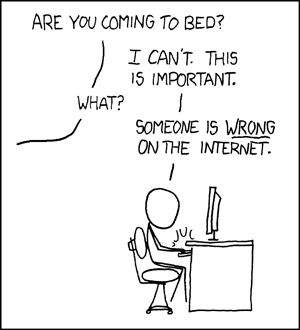
But then there is the less grave version, best set out in this cartoon from xkcd. It is an odd thing. It does not involve the sense of importance of the case above, you generally know that no one's mind will be changed, but you MUST make that comment. It was one of the rules of blogging that I learned early on -- people only comment if they think you are wrong. If they read and agree, they'll just think, "hey, well said," and move on. but if they think you were sloppy, missed the point, or completely missed the boat, then man the comments come in. And then, of course, those who thought you were right feel compelled to defend you and respond to these errant responses. Next thing you know, folks are having fun.

It is a strange reflex. I'm not sure if it is more likely to occur on-line. If so, I'm not sure if the facelessness encourages it or what but I agree with Chris that it is a phenomenon widespread enough to deserve a catchy name.

Suggestions?

Wednesday, June 25, 2008

Field Values, Teaching Ethics, and Sheroes as Role Models

C. Ewing gives us three questions. Taking them in order:

precisely what work is accomplished by physical objects so far as the theoretical is concerned? I'll readily concede that it fits our intuitions better (or at least, most of our intuitions), but what does the existence of physical objects do that is of particular importance? If you prick me I bleed, surely, but do we need blood and sharp objects for that?
Actually, modern physics does away with the notion of object altogether. Everything ends up becoming (oversimplifying a bit) blobs of field values that are more or less localized in spacetime. Parts are made up of smaller parts, but when you get down to subatomic size, objects lose what philosophers call "genidentity," that is unique selfness that differentiates them from other basic objects and everything can be seen as waves in a great universal field.

Number two:
Is ethics or moral thinking (whatever term we're liking today) something that can actually be taught, and assuming it is, must it be taught whilst young? It seems sensible (in some manner of speaking) when we say things like, "He just wasn't raised right", but later in life (and I don't think I'm alone here) we deal with cyclic behavior that intellectually we know is bad for us (and possibly others), yet seem to have an absurdly difficult time changing behavior that we know should be changed. Are we just dense as grandmum's biscuits or is there something to the Catholic idiom, "Get 'em while they're young"?
Doing the right thing is a two-step process. Step one (moral deliberation) is deciding what is the right thing to do in your context. Step two is doing it.

Step one is taught when we are young. When children do something wrong we not only correct them, we explain why their action was wrong or at least what the proper action should be (or if there are less enlightened parents, the children figure out which things they don't get yelled at or beaten for). Of course, these lessons break down for the tough moral conundrums and that is why philosophers still have jobs.

Step two is a function of character. While there is no doubt that some degree of personality is innate within each of us, the way we choose to behave and the decisions we make are often -- as Aristotle rightly observed -- a function of habit, habits that are often (but not always) formed when young by observing how others act and by positive and negative reinforcement. You see an out of control child and when you meet the parent, you are rarely surprised. While some people are likely more naturally empathetic than others, empathy (or guilt or fear) can be encouraged or discouraged when young and this will screw you up for the rest of your life, although it can be mediated by a good therapist.

And lastly:
On the topic of super heroes: are characters like Supergirl, Power Girl, Wonder Woman and Wonder Girl, etc., beneficial to women or does the sexual appeal undercut the good that can be done? Does the good message of strong, smart, assertive, independent women get low-balled by cup size and wardrobe?
I think the costumes are part of the problem. I always thought with Wonder Woman's invisible plane that surely people were constantly saying, "Hey, who is that scantily clad woman squatting across the sky?" But an additional issue is that they are just male superheroes -- displaying culturally gendered masculine behaviors -- in women's bodies. There is still the black and white, absolute good versus absolute evil plot lines, violence and force are seen as the only justifiable means of dealing with those who are "them." If my daughter were to look for a fictional hero, those would not be the ones I would encourage as they are certainly pregnant with classical patriarchal baggage.

On Epiphenomenal Qualia and Lacrosse

Justin asks,

I'm trying to figure out how to phrase this. I recall talking in one of my philosophy courses that if someone makes a sudden movement, apparently the neurons the cause the muscle movements fire before the ones in our brain that allow us to be mentally aware of the movement. Some have argued that this is evidence for "epiphenomenal qualia". I remember reading some criticisms of this argument, but I can't for the life of me remember them. Do you know what they are or if there are any legitimate ones?
Let's first explain this wonderful term "epiphenominal qualia."

Qualia is the easy one, it's just the content of our experiences -- the redness we actual sense, the pain we feel, the ticklishness of the tickle. There are brain states associated with all of our experiences, but the qualia are not that, they are the actual lived sensations.

Epiphenomalism comes for an old debate in philosophy concerning the nature of reality. Humans were held by many to be composed of two parts: (2) a non-material body or soul that served as the seat of reason and volition, that transcended after death to be judged for the decisions it made, and (2) a material body that decomposed back into the earth after death, but had all the fun first. This view that reality had material and non-material elements is called dualism.

A concern for the dualist is the problem of interaction. We know how material things are affected, they are pushed on by other material things -- that's what the laws of physics describe. The non-material entities are ideas or forms of some sort, so they interact with each other according to laws of logic or psychology. But how do they interact with each other? If minds are non-material, but could causes the body to move that would violate the laws of physics. Further, by what mechanism could it possibly happen? And the same in the other direction, how could a body on body interaction cause a change in mental states? If these things are completely different sorts of stuff, they shouldn't be able to affect each other.

There were four options: (1) avoid the question by surrendering dualism and say everything is matter or everything is mind, (2) come up with some explanatory mechanism, Descartes tried (3) claim that the two happen on parallel tracks and look like they interact but don't -- Leibniz's pre-established harmony, and (4) epiphenomenalism, they view that the body can affect the mind, but that the mind does not affect the body thus allowing sensation without violating the laws of physics.

From this classical sense, Frank Jackson, starts this discussion in his famous paper "Epiphenomenal Qualia" in which he openly declares himself "a qualia freak" proving once again that philosophers have the world's most boring fetishes (I've always had the image of Jackson at the moment of ecstasy shouting "Red, here, now. Red, here, now. No mere protocol sentence could contain this!) argues that mind states and brain states are different (the functioning of the nerves and the pain section of the brain is different from the "Ouch!"), that brain states give rise to mind states (the pain receptors and the brain are needed to cause the "Ouch!"), but that mind states do not affect brain states (the "Ouch" can't cause anything, it is merely experienced)-- hence, epiphenomenal qualia.

So, now let's finally get to Justin's question. It is true that the startle reflex and many other bodily functions operate the the pre-conscious level, that is they cause action before the signal has reached and been processed by the rational parts of the brain. When I was a lacrosse goalie, for example, I would routinely (o.k., occassionally) stop shots going around 100 miles an hour from not all that far away. I was watching and I would move my body and hands in a very specific fashion, but it was not a conscious decision. It was such a bang-bang event that i would never have had time to process what needed to be done. Does this stand as a supporting instance of Jackson's epiphenomenal qualia? Since it happens faster than the conscious mind can process the sensation, analyze it, make a decision about it, and then sense out the signal to the body about what to do, it seems epiphenominal, that is, the experience doesn't cause the bodily motion.

Jackson is not arguing that all qualia are epiphenominal, just some which is all he needs to undermine the physicalists' claim that minds do not exist and everything is material responding to physical laws.

The strongest objections seems to me is to hold that it wasn't me who stopped the shot, that is, I (me, the conscious Steve with a mind) didn't move my hands, my hands were moved my body independent of me and my will, hence it was a conditioned reflex, just a plain old body/body interaction. Coaches always tell athletes not to think (which, for most lacrosse players, is their natural state), that thinking only screws up performance. Everything must happen on the precognitive level and this is why we train, so that the body simply takes over.

Indeed, this was one of the things I loved most about playing. It was a time when my brain was off, yet (and this seems to speak in favor of Jackson) I was hyper-aware. At the same time, the awareness was not exactly what I would call sensual (or sensuous, for that matter). That is, I felt myself a part of the game, but didn't really feel the sensations. So, (and this would be a point for the anti-epiphenominalists) where were the qualia?

More questions tomorrow.

Tuesday, June 24, 2008

Fruitcakes?

Guestpost today from YKW:

There are few people I truly hate (politically) more than would-be demagogues like James Dobson. He’s the second coming of Henry Ford, minus the cars.

(CNN) -- A top U.S. evangelical leader is accusing Sen. Barack Obama of deliberately distorting the Bible and taking a "fruitcake interpretation" of the U.S. Constitution.
In comments to be aired on his radio show Tuesday, Focus on the Family founder James Dobson criticizes the presumptive Democratic presidential nominee for comments he made in a June 2006 speech to the liberal Christian group Call to Renewal.

In the speech, Obama suggested that it would be impractical to govern based solely on the word of the Bible, noting that some passages suggest slavery is permissible and eating shellfish is disgraceful.

Dobson sticks his foot directly in his own mouth of course, and shows why the evangelical movement he heads is so offensive to so many, when he starts by saying that Obama shouldn’t be referring to antiquated dietary codes and passages from the Old Testament that are no longer “relevant” to the teachings of the New Testament.

Hello? There are several million people, voters the last time I looked, who if they don’t actually follow the dietary codes of the Old Testament, at least give them a measure of respect in their daily lives. We’re called “Jewish People.” If you read the Bible, James, you’d see us referred to as the “Chosen People.” By God. Obama’s point is that running public policy by a Bible that few people follow or can even agree on is a bit unwieldy, and probably not the way we’re supposed to compromise in a democracy, to say the least. And Dobson up and proves it by offending all of the Old Testamentary Jews in one broad swoop.

Obama and the Evolution of the Complex

Two more today:

R.Porter asks,

how many more times does golden boy Obama have to do something as f'd up and *Republican* as his FISA vote until his supporters realize what they've foisted on the party? I'm not just being smug, either. If this is a one-time lapse, then obviously I'm overreacting. However, if this is a trend - and if you look at his biggest piece of legislation since he's been in the Senate, the E85 bill, the trend has at least two data points now - I think we have to wonder when the rose-colored glasses come off.
I guess the answer to this question depends upon what glasses you assume Obama supporters to be wearing. Anyone who thinks Obama is a taller better-looking Dennis Kucinich is simply wrong, but then I'm not sure many of the folks who support Obama really interpret the message of hope and change as one of a full-throated all out progressive attack on the last administration and a half.

Obama has never called for the implementation of the progressives' agenda, but rather a change to the way things are done, that is, an end to the hyper-partisanship where everything is seen as nothing more than opportunities to demagogue. This can take one of three forms: (1) what we now call "bi-partisanship" which is meeting the other side in the middle, (2) what we saw in his work with Dick Lugar and Tom Coburn in the two bills that bear his name in which you take an issue that Dems and GOoPers disagree about, find some area where there is common interest and craft something that fits into both agendas, and (3)passionately arguing for something that is partisan, but doing so in a way that does not create a strawman out of your opponents.

If you look at Obama's career, he has used all three paths, deciding which path based on pragmatic considerations. The case of FISA is an example where he chose (1) and we wish he had chosen (3). I'm with you that (3) would have shown leadership and real interest in the rule of law. But it was a battle he chose not to fight at this time, most likely for political reasons. It does allow administration and telecoms to get away with having broken the law and reinforces the Nixonian notion that if the President decides it doesn't break the law, then as an analytic truth, it doesn't break the law. This IS a bad thing.

At the same time, to argue that this is evidence that something horrible has been foisted upon the party by putting someone in charge who runs the most most effective party registration and voter sign-up operations we've ever seen thus laying the groundwork for Dem electoral gains for decades, who chooses Samantha Powers as a foreign policy advisor, who has worked for the voiceless, and who has shown an incredible political sense infused with a positivity we have not seen from a Dem in a long time seems an overstatement. No, he's not going to be a progressive's wet dream. No one who is paying attention believes that. Yet, he will certainly bring in with him a wide array of new voices, shaking up the stagnant backwater that has been Democratic politics for the last two decades. Some of what gets churned up will be scum (FISA is one example), but then it also seems likely that some pearls will be found that otherwise wouldn't as well.

John Steward asks,
I believe in evolution but I don't understand how it accounts for the complexity of the world. What's the relationship between complexity and evolution?
The tough part about this question is the slippery nature of the word "complexity." The arguments for design based on complexity can be found as far back as Aristotle, but really take there modern form with William Paley. The idea is that there are systems whose parts are so perfectly designed that random mutations, which would only bring parts, could not account for the intricate way these parts interact. The workings of a watch, of example, are so perfectly fitted that they could only be crafted, must be an artifact of an intelligent watchmaker.

The standard example if the human eye which contains many parts, none of which by itself is seemingly useful. If random mutations gave us bits, there is no reason why they would be selected for, the argument goes, hence the most reasonable explanation for eyes must be design and not natural or sexual selection pressures.

One can account for the complexity of the eye through evolutionary means both through negative and positive argumentation. The negative route, showing problems with the design argument, tends to take two lines. First, there are a multitude of different sorts of eyes among living beings, although we tend to find the same sort among related species who inhabit the same sorts of environments, variations found among similar eyes based on environmental factors. Second, flaws in the design of the eye are pointed to -- most normally the placement of blood vessels in front of the retina, something that no decent engineer would ever do. If the supposed designer is maximally intelligent, surely HE wouldn't have made such a blunder.

The positive argumentation is to look for transitional forms of the eye in past and current species. indeed, we do find such evidence in the world that would account for the differentiation of the parts of the eye. Each example of complexity needs its own story to be told and that story needs to be supported with empirical evidence. Not every explanation about advantages conveyed are actual histories of biological complexity, but there are examples of such that can be recreated.

Two more tomorrow.

Monday, June 23, 2008

RIP George Carlin

Brothers, Sisters, and Transgendered Comedists Everywhere,

We lost a giant. George Carlin is dead.

Carlin and Richard Pryor were the link between Lenny Bruce and pretty much every single comedian of the last forty years. Carlin took Bruce's ability to talk about the new, the shocking, the edgy and made it tight and funny, brought it back into the more standard stand-up format.

His work was often political, anti-institution, anti-religion, pushing the boundaries. In this respect, his routine "Seven Words You Can't Say on TV" was the bit that made him a household name. But just as often, his routines were straight ahead skit-type comedy, as with his fake news casts featuring (my favorite) Al Sleet the hippie-dippy weather man, with all the hippie-dippy weather, man, or straight ahead observational comedy as in his famous comparison between baseball and football.Fact is, he was an incredibly smart man who was a master jokesmith and a performer par excellence. He will be missed.

A few great lines:

Hansel and Gretel discovered the ginger bread house about 45 minutes after they discovered the mushrooms.

And, of course, the funniest food: "kumquats". I don't even bring them home. I sit there laughing and they go to waste.

If the #2 pencil is the most popular, why is it still #2?

Don't sweat the petty things and don't pet the sweaty things.

When someone asks you, A penny for your thoughts, and you put your two cents in, what happens to the other penny?

I've begun worshiping the sun for a number of reasons. First of all, unlike some other gods I could mention, I can see the sun. It's there for me every day, and the things it brings me are quite apparent all the time: heat, light, food, reflections at the park -- the occasional skin cancer, but hey. There's no mystery, no one asks for money, I don't have to dress up, and there's no boring pageantry. But I don't pray to the sun - it wouldn't be polite to presume on our friendship. You know who I pray to? Joe Pesci.

Frisbeetarianism is the belief that when you die, your soul goes up on the roof and gets stuck.

Why is the man who invests all your money called a broker?

And finally,

I'm always relieved when someone is delivering a eulogy and I realize I'm listening to it.

What were your favorite Carlin lines or routines?

Thank you George Carlin for all the years and all the laughs.

Live, love, and laugh,

Irreverend Steve