Monday, June 13, 2011

Sex and Power

Anthony Wiener is just the latest in an on-going string of political sex scandals. Is the correlation between politics and infidelity real or apparent? It seems there are four main possibilities:

1) The rate of inappropriate sexual behavior for politicians is higher than in the general population because the power and celebrity involved in being a politician creates more opportunities. Given more opportunities, it is natural that there will be more cases.

2) The rate of inappropriate sexual behavior for politicians is higher than in the general population because politics self-selects for a certain personality type which is more likely to engage in such behaviors. These are people who constantly seek self-aggrandizement and pursue their goals relentlessly and these tend to make infidelity more likely.

3) The rate of inappropriate sexual behavior for politicians is higher than in the general population because of the nature of the job. One is working very closely with a set of associates, often on the road with them, often away from family. The close-knit and care-based relationships that politicians have with their aides and staff and the large amount of time they spend away from their spouses leads to a larger number of instances.

4) The rate of inappropriate sexual behavior for politicians is not higher than in the general population. It just seems higher because your neighbor's affair does not make national or local news and so you may or may not know of it. Politicians are celebrities of a sort and the appearance comes from the fact that it gets reported and re-reported.

So, which is it?

Saturday, June 11, 2011

Manna from Comedy Heaven

My Fellow Comedists,

You know, you hate to look a gift horse in the mouth, but sometimes the Cosmic Comic sends a set-up so easy you wish for a challenge. Crotch shots by Congressman Wiener. The only thing easier IS Congressman Wiener. It leads to the obvious question, what is the easiest set-up you ever received.

I was teaching an ethics class and discussing the difference between moral precepts and social mores. When a student asked "Steve, what are mores?" I simply responded, "When the moon hits your eye like a big pizza pie, that's a more."

What's the easiest set up you ever got?

Live, love, and laugh,

Irreverend Steve

Friday, June 10, 2011

Anonymous Anonymous

Today is the 76th anniversary of the founding of Alcoholics Anonymous. While there is considerable debate in the public health community about its efficacy, the model has been applied to virtually all other forms of addiciton, from Narcotics Anonymous to Gamblers Anonymous, from Sexaholics Anonymous to Workaholics Anonymous. So ubiquitous is this approach that some are considering beginning Anonymous Anonymous for those addicted to attending 12-step meetings. The first step is admitting that you are powerless over you ability to stop admitting that you are powerless about admitting that you are powerless.

You have some like psychiatrist Thomas Szasz who question the very category of addiction. While that's a good conversation to have, I want to assume that addiction is a real psychological problem, but ask whether it ought to be seen as a psychological or sociological concern.

Given that certain substances and activities cause changes in brain chemistry that lead some people to alter their behavior in irrational and undesirable ways, are there social structures and institutions that create an environment where we would expect an increasing number of addicts to be created? Since there is a significant amount of profit to be made from the sources of addiction, whether it be nicotine, slot machines, alcohol, or cocaine, and since we live in a culture where money is equated with political speech and influence, should we be sending individuals to programs or should we be starting a regulatory 12-step program to a healthier society? Are there things that we could do to create a culture that is less likely to create addicts? We say that this is the land of the free and that we love liberty, but with fast food chains and sugared cereals advertising to our children, with payday loan sharks and liquor stores populating our poorest neighborhoods, with Starbucks as the go to hangout for the cool and busy, aren't we setting ourselves up to make all of us dependent on this or that? Is addiction a foreseeable and preventable tragedy of modern cultural structure?

Thursday, June 09, 2011

Does God Hate Right-Wing Christians or Is Global Weirding Real?

We've had a lot of significant weather events lately from flooding along the Mississippi and in the Dakotas to tornadoes through the South and Midwest. What is interesting is that the places where these weather events are occurring are also the places where we find significant support for conservative Christian right-wing politics. When Katrina hit New Orleans, we heard from some of these folks that it was God's revenge for the Big Easy's sinful ways. Similarly with 9/11 in which they said that it was NYC's liberal essence that led to its destruction. If this is true, then surely the fact that we have repeated tragedies in the Bible Belt should be place for the same sort of inference. Could it be that God despises right-wing fundamental Christianity and is showing his disapproval with these weather events?

I suppose we could look elsewhere for explanations. Global weirding, the increase in unusual weather events, is predicted as a consequence of global warming. More warmth means more energy in the system and that added energy has real effects. That might be one way to account for it, but then, of course, you'd have to allow for global warming and that would make you one of those evil, lefty, moonbat, eco-freaks...or a scientist...

Maybe they're both right. Maybe God designed the Earth with a very specific climate and the fact that we're changing it and making him uncomfortably warm ticks him off and what we're seeing is a message sent to those who are opposing action on reducing our overall carbon footprint. If you don't want any more Joplin, Missouris, we better enact cap and trade soon.

Wednesday, June 08, 2011

How Transparent Are Our Minds?

In a conversation last week, a gay colleague referred to an acquaintance as so deeply closeted that he (the acquaintance) never realized himself that he was gay. It struck me as an interesting thing to say -- a case of purported false consciousness -- and it's rattled around as I've worked this week on an explication of Descartes' writings.

According to Descartes, an evil demon may be fooling me about everything I believe, even controlling the thoughts I have, but I cannot be wrong about two things: first, that I exist, and second, that I know what I am thinking. What I am thinking may be false, but I cannot be wrong when I assert that I am thinking it. Since wanting is a form of thinking, I'll always know what I want and that I want it. On this view, our minds are transparent to us.

Freud most famously contended the opposite, that the conscious mind was but a small bit of the full mind and that beneath the surface lots of activity is happening that leads you to think you want certain things, when in fact you are merely displaying displaced desires, suppressing your true wants and replacing them with something more acceptable. The trained psychoanalyst occupies a special place where he can glimpse elements of it and tell you about it, but many of our true desires remain hidden to ourselves.

Who is closer to right here? Descartes or Freud? Do we know our minds or do we only think we do? Or do we only think that we only think that we do?

Tuesday, June 07, 2011

Fairness, Logic, and Scarce Resources

I teach logic every fall semester and being one of the more challenging courses, the college allows me a peer tutor, a student from the previous year's class who helps out by giving attention to students who desire it. It's not only helpful to the logic students, but something nice for the tutor -- a little extra cash in pocket and a nice line on the resume, especially for someone looking to go to graduate school. To have experience in a TA-like position, to have had the trust of a faculty member, and to be able to display mastery of a tricky part of the field are all pluses in a tight field of folks trying to get into Ph.D. programs.

This coming year, I've got a good one, someone who did very well in the class, is very patient and personable, and is seriously thinking of grad school. I've never had to face this type of situation, but suppose one year I had two candidates who both did equally well in the class. One is more articulate, creative, or outgoing -- traits that are useful when dealing with students who are uptight and frustrated. This one candidate who would have the edge all other things being equal is not thinking of graduate school in philosophy, but the other candidate is. The second candidate would certainly be qualified and if the leading candidate had not been in the class, I would have no qualms making candidate #2 the peer tutor. He just wouldn't be as good as #1. But in the long run, having been the tutor will be more useful for #2. I could write him a stronger letter of recommendation, he could say things in his application that would help him get into difficult programs, he would increase the likelihood of fulfilling his goal which I share -- he'd make a fine philosopher someday.

Should this be part of the criteria for deciding who gets named peer tutor? Is that fair to #1?

Monday, June 06, 2011

Is Facebook Making Class Reunions Obsolete?

When the VCR first hit the market, movie theater revenues were in a slump. Given the industry's tough times, the idea that people could now skip the cinema altogether and watch films cheaper in the comfort of their own homes led many to predict the collapse of the multiplex era. But, in fact, the opposite happened. The convenience of the VCR reminded people what they loved so much about movies and suddenly ticket sales climbed dramatically.

It is against this backdrop that I watched the class reunions on campus at Gettysburg College last week. The fun of a reunion is to see the folks you really liked, but fell out of contact with. Is he bald yet? I wonder what she's been doing for the last couple years? Do they have one child or two?

But with e-mail lists and especially Facebook, we are less and less losing contact with those folks. People I would never contact on even an annual basis, I now get frequent updates about. I know when their kids have thrown up, when they went to the gym, even when they divorced that really cool person whom I frankly liked better than them. In a sense, Facebook and other online tools and play toys serve the purpose of the class reunion.

Does that mean that there is less reason to go to the reunion, making it an obsolete institution or, like the VCR case, do you feel so much more connected to those in your past that it makes it more likely that you'd want to spend face time instead of just Facebook time with them?

Saturday, June 04, 2011

Funny Final Words

My Fellow Comedists,

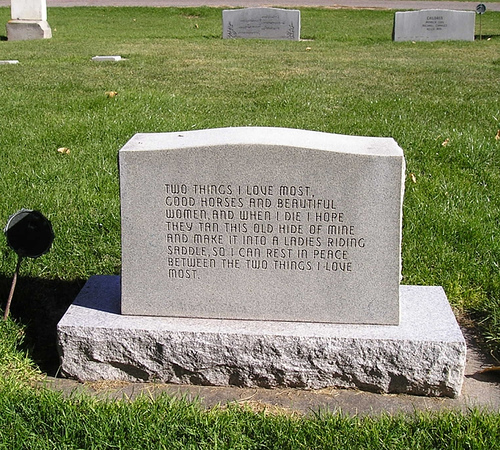
Leslie Neilson's gravestone has been put into place and at his request, here's what it says:Nothing like going out with a fart joke. While it is not there, W.C. Fields had asked for his to say, "All things considered, I'd rather be in Philadelphia."

There's a certain level of comedic devotion to have your final linguistic representation on Earth be funny.

The, again, having your mates do it for you is another level altogether:


Live, laugh, and love,

Irreverend Steve

Friday, June 03, 2011

Fill in the Blank: Whom Should We Be Reading?

The department has launched a new class we call "Reading _________," where the blank is filled in with the name of someone who is not considered part of the standard philosophical canon, but whose writings hold deep interest in terms of the history of ideas. Last year, I had a seminar reading Darwin and a colleague has done it with the works of Gandhi. Next year, I'll be doing it with Emile Durkheim and Max Weber, founding fathers of sociology. What other figures can you think of whom we don't usually consider to be philosophers, but would be fun to study philosophically?

Thursday, June 02, 2011

Does Teaching Require Sacrifice?

I was in the doctor's office yesterday reading an old copy of Smithsonian and came across a fascinating article on chimpanzee behavior. While tool use has been observed many times in many contexts, learning is transmitted through an apprenticeship model where younger chimps observe older ones at work and then figure it out through trial and error on their own. What has never been observed is chimpanzee teaching. Technology is transmitted passively, never actively.

For a behavior to be considered to be an instance of teaching, primatologists contend that it has to satisfy three criteria:

(1) It has to be goal-directed on the part of the teacher with the goal being the acquisition of knowledge or a skill by another.

(2) It has to have an assessment element, that is, there must be evidence of reward or positive sense given for good work, correction or negative feedback for mistakes, or some sort of corrective action when the learner is off-track.

(3) There has to be some sort of price or loss for the teacher. The behavior must keep the teacher from getting the pine nut to eat him/herself or it must keep him/her from being able to do something else that would be more personally beneficial.

As a teacher and a primate myself, the third criterion struck me as odd. I began to wonder whether I satisfied that condition as a collegiate instructor. Do I suffer at all from teaching? I suppose there is other stuff I could be doing, but frankly teaching is one of the things I enjoy most. For some reason, they pay me for doing it, so rather than a loss it is a gain -- now, sure, there's probably something to be said about philosophers' salaries, but relative to the philosophers' work load (I can't believe I just typed that phrase)...

It certainly doesn't seem to fit the graduate student/thesis director relationship, but perhaps that is to be considered indentured servitude instead of teaching. While that was in part meant to be sarcastic, it does seem appropriate to rule that out as teaching. The condition does seem to come from the intention of separating out training underlings to do your bidding from the act of teaching which should be more purely other-directed, that is, an activity undertaken for the sake of the learner, not for the sake of the teacher.

But is that really necessary? Do I have to give a darn whether the class members are improved? Can I be teaching in a completely selfish way? Suppose there's a book I've always wanted to read and I know that I'll understand it and appreciate it better by breaking it down in a fashion that looks just like a lecture and classroom discussion? Did I teach the book if I gained rather than sacrificed?

Wednesday, June 01, 2011

Boobies, Ta-Tas, and the Ethics of Titillating Advertising Tactics for Non-Profits

Schools have been having issues with the breast cancer awareness campaign in which bracelets are sold with the slogan "I love boobies." Similarly, cars across the country sport magnet signs urging us to "Save the Ta-Tas." There is no doubt that we need more research into the causes and treatment for breast cancer and to promote awareness in order to detect treatable cases earlier. Seemingly, anything we can do to foster this good end would be desirable.

Those who consider ways in which to raise this money no doubt realized that they had something that colo-rectal or esophageal cancer advocates didn't -- they had a part of the body that Americans are obsessed with. The earlier approach based on "it's about your mother and sister, and don't you love them, let's all wear pink" was effective, but surely "boobies" and "ta-tas" could -- and did -- become a cultural phenomenon. Given the attention we pay to breasts, shouldn't they use it to help save lives?

Or is the use of such objectification only further entrenching it? The breast cancer folks are not the first to use these tactics, consider, for example, PETA's Naked campaign in which they got famous actors, male and female, to pose nude under the tagline, "I'd rather be naked than wear fur." They are using cultural elements that are not ethically healthy for the society, that undermine unhealthy approaches to sexuality. No one is saying that breasts or nudity are inherently problematic, there is nothing wrong with either, but the folks running these ads know they are doing it in a fashion that is consistent with a certain approach to them -- it is cheap titillation, something that works every time. They are making themselves the Porky's of non-profits.

The response to such a line is often, "Lighten up." Maybe that's a valid response. It's just a joke, it's not hurting anyone, and it's helping people. Or is it subverting deeper virtues that need to be emphasized in the name of caring for those in need? Is there a problem here or is it just good advertising?

Tuesday, May 31, 2011

The Pedagogical Value of Gardens

NPR has been running a series on financial literacy in which people are arguing that it is essential to work into middle and high school curricula modules teaching children about money and how to handle it. Last week, I was chatting with someone who made a similar claim about a different aspect of human life -- food. She contended that all schools should have gardens. No child, she argued, should be considered educated who has not acquired some sense of how food grows and what it looks like when harvested. I didn't mention to her that my children's school does exactly that and during the spring, they spend time getting their hands in the soil and enjoying the fruits -- or vegetables -- of their labors as a class. It is something I really love about their school. It makes me think of the end of Candide. Perhaps part of learning is tending to one's garden in a non-metaphorical sense.

But is the general claim true? Is this just a nice thing or should ALL schools have a garden? Are there lessons one learns in the garden that are essential and can be learned no other way?

Monday, May 30, 2011

In Memorium of Body and Soul

Memorial Day always makes me think of my grandfather who served during World War II. He had stories about the war that were curious, funny, sad, shocking, mysterious, and telling of the human condition. My sense of war comes in large part from the man, many tales he wove from his Lazy-Boy as I sat on the couch.

He had lived a full life: raising a family, running a business, raising orchids and making bonsai trees, kibitzing with everyone he met. But the defining time of his life had been World War II, during which he had been a paratrooper in the 82nd Airborne, jumping behind the enemy lines before D-Day. As a teenager, I would mow my grandparents lawn and then sit with him for hours listening to old Yiddish jokes, arguing politics, and hearing the war stories. He always made sure that I knew that it was the convicts, colorful criminals with off-color pasts, let out of jail so they could serve in this unit that brought him home alive. And though it remained unsaid, it was always clear that in some indirect way I owed my existence to these people I was very lucky not to have had to associate with. Big Boy Buchanon, Jimmy D, the whole cast of them led to stories that might have been left on the editing room floor after shooting the Dirty Dozen. They were exciting, they were funny, they were poignant. Those were Pop Pop's stories and I heard them all countless times.

I was very fortunate that he and my grandmother lived only minutes from Johns Hopkins, where I was finishing my dissertation, so I could be close by. His last couple of weeks were clearly his last couple of weeks, so that I and the family as a whole could be with him. In the end, it was the cigars, not the Nazis, that finally got him.

But one thing about my grandfather's death that will haunt me until mine, was the way the war would not let him go. Even though he was surrounded by the people he loved most in the world, the war commanded his soul with an frightening ferocity. We all sat with him up in his bedroom; but in his last two days he drifted back to Europe and north Africa during the war. Sometimes it was hallucinatory, other times he knew he was in his bedroom, but he couldn't pull his mind off of the war. I saw in my grandfather's face something I had never seen before, it was beyond fear, it was true horror. And he would not talk about it. I tried for two days, hoping that describing it would exorcise it from his spirit. His agony was not from the disease of his body, but something in his mind. It was so painful to see my beloved Pop Pop in this anguish that I gladly would have taken the burden. But he would not speak. He would not dare expose me to whatever it was. His last act on Earth would be to protect his loved ones from his deepest demons the way he had protected the country decades before.

I will never know the particulars of it, but I know full well what it was. It was post-traumatic stress disorder, PTSD. With the advances in medical technology and so many returning from Iraq with grave injuries that would have killed them in wars past, we are all too easily turned to the body in thinking about permanent disfiguration. The loss of limbs or paralysis will be this generation's version of the homeless Viet Nam vet muttering to himself. But it is the psychic injury that will linger. Some will not recover from it, others will go on to be able to lives lives that seem normal and productive from the outside. But the effects of war on the mind will linger dormant. But they will be there.

And not for soldiers only. Indeed everyone who lives in the affected area will themselves be touched in a way that will never allow for life to be completely normal. We have entire nations now full of children whose brains have been altered by exposure to what we are capable of doing to one another.

So, on Memorial Day, when we think of those who have sacrificed their lives, we think not only of those who never came home, but also those who did, forced to leave part of their soul behind.

Saturday, May 28, 2011

Funny Funnies

My Fellow Comedists,

This weekend the Reubens are announced. Named for Rube Goldberg, the Reubens are the awards of the National Cartoonists Society. Awards are given in thirteen categories from feature length animation to greeting cards. You can see all the nominees here.

From Saturday morning Scooby Doo for kids to The New Yorker for sophisticates, cartoons have become an accepted part of the comedic landscape. In any cartoon medium, what is the funniest cartoon you remember?

My favorite has always been this old Bloom County:


Others?

Congrats to all of this year's Reuben winners.

Live, love, and laugh,

Irreverend Steve
Friday, May 27, 2011

Dying Malls

Heard a story on NPR that retailers are optimistic about the resurgence of malls. Not sure if I share the feeling. Several of the malls around me are eerily empty, both of shoppers and stores. Malls that had been central locations in the community are now barely on life support. In the 70s and 80s, malls replaced the old department stores and discount stores like Woolworth's. but now, the next generation of department stores and discount stores, combined with on-line malls like Amazon and eBay, have struck back. Is the pendulum going to swing back? Will malls see a resurgence with the economic recovery or are their days as social gathering spaces and retail outlets done? Have big boxes and point-and-click finished them off for good? Are malls terminal?

Thursday, May 26, 2011

Medicare Semantics

Democrats are arguing that Paul Ryan's approach to replace the current Medicare system with one of vouchers for private insurance for seniors kills Medicare. Republicans respond that this is a falsehood meant to scare older voters. Many reports in the media label Ryan's proposal as an attempt to "fix" Medicare, that is, not to do away with it, but to keep it in a different form. Democrats argue that the form is the essence of what it is and such a radically different system is not Medicare, but something else. Who is right here?

Medicare is a government run, single-payer system in which the costs of helath-care (with the exception of some prescription drugs) is covered directly by the government. Ryan's system is one in which a fixed amount is given to seniors in the form of vouchers and seniors then go out on the open market and purchase their own coverage through insurance companies. If their costs outrun their voucher amount, seniors are on the hook for the rest. So, unlike the current system, not all medical bills will necessarily be covered for standard, required care.

The question then is which of the follow three possibilities is the correct one:

1) "Saving Medicare" Ryan's plan is a form of Medicare, just one with a different internal structure. If one had a manuscript and a copy editor made some adjustments to the prose, so it flowed better and was grammatically correct, one would never say that the edited manuscript is a different book. Rather, it is a better version of the original book. In the same way, Republicans are arguing that Ryan is not ending Medicare or replacing Medicare, just making some adjustments within it. Medicare may make radical changes, but it is the program that changes and so the program exists before and after the alteration. Medicare has gone nowhere, it just has been restructured.

2) "Changing Medicare" The picture here is that the two are not identical, but similar enough to be grouped together. Where the first option considers both to be the same thing, number 2 takes the name "Medicare" to be one in which a book is adapted to a screenplay. If one can argue that the first Harry Potter book and the first Harry Potter movie are the same story, then one could argue that the Ryan plan and Medicare are the same program. "Medicare" means any government run and funded program that helps seniors pay for medical expenses and while the current program and the Ryan plan are different programs, they both fit under the heading "Medicare."

3) "Ending Medicare" The Democrats' line is that the single-payer non-market-based approach is the defninitional element of Medicare, remove that and what you have is no longer Medicare. They look at the Ryan plan as undermining the nature of Medicare and while you could call the Ryan plan by the name "Medicare," it isn't. It would be like buying every copy of War and Peace and burning it, then buying every copy of Moby Dick and pasting a sticker with the words "War and Peace" on the cover. You could not claim that War and Peace still exists by pointing to the altered editions of Moby Dick. Moby Dick is not War and Peace just because you've decided to now call it that. In the same way, Ryan's plan is not Medicare, they argue, even if you want to call it "Medicare."

So, which is the most accurate description, 1, 2, or 3?

Wednesday, May 25, 2011

Oprah, Bob Dylan, and Middle Class Neuroses

Yesterday was Bob Dylan's 70th birthday and today is Oprah's final show. In a certain sense, the work of both have been about the same exact thing, the neuroses of the American middle class.

Dylan's rise to prominence came as a result of his song-writing when folk music had a certain cultural place. Woody Guthrie, the Weavers, and others had a social edge to them, but the Kingston Trio, Peter, Paul, and Mary and others softened it. Folk music was never seen as dangerous until Bob Dylan put anger in it. His was a sardonic, literary venom that appealed to the young baby boomers who saw themselves as smarter than the past, above history. He put his finger in the wounds of an unjust society showing how the privileged were not only failing to insulate themselves from the sickness of the larger society, but becoming ill in very particular ways from it. When he asked "How do you feel?", he knew full well that Mr. Jones was not well -- and it wasn't because of the yelling of the one eyed midget, either. The class-based culture of American life had poisoned the comfortable. Ward and June and Ozzie and Harriet were not true models of life for the new suburban middle class in Levittowns across the country. The new, post-war, post-industrial modern reality had a dark side and Dylan's sharp lyrics pointed at the contradictions and hypocrisy that lay right beneath its claims to moral, social, and spiritual superiority.

But then those baby boomers got older, got married, got jobs, and had families. Who did they try to become? Exactly those that they sneered at through Bob Dylan's songs. They became "the man" -- even the women. And by stepping into the complacency of that middle class privilege and electing and re-electing Ronald Reagan to protect it, they contracted exactly the disease that they let Dylan diagnose in the previous generation. They got the sickness of the soul. And then along came Oprah.

Phil Donohue, a smart gentle soul, had already been there trying to point out the ailment and its symptoms and effects in a way that didn't upset anyone. But his attempts were neutered by the network. Forced to bring on a never-ending parade of circus freaks instead of his friends like Ralph Nader, he was made to turn himself from a younger Bill Moyers into a proto-Jerry Springer.

That left the space of family spiritual physician open for Oprah to fill. Her canvas was the wide range of middle-class neuroses that plagued those with privilege. Their lives were not as advertised and whether it was with Dr. Phil, Dr. Oz, or any number of other recognized or self-appointed doctors, Oprah became the sociological HMO of the nation. Her prescriptions, while sometimes effective for some side effects and sometimes not, were exactly the sort of medicine that the baby boomers wanted to take; they appealed to the self-indulgent baby boomers who would never take responsibility for their own sickness, the one they knew all about from the lyrics of Bob Dylan.

And so we are here with an old Bob Dylan, a departing Oprah Winfrey, and everything contagious that they both pointed out for decades. Yet the patient is not ready to go to the hospital, the large scale changes in the American way of life are not in the offing. Will it take the cultural version of a heart attack? Maybe, but even if such a trauma occurred, you can be sure that the only sound that could be heard after the ambulances go, will be Cinderella sweeping up the cash on the Disney channel.

Tuesday, May 24, 2011

What Hath God Wrought? How Modern Time Was Born Today

One hundred and sixty seven years ago today, Samuel Morse sent the first telegram from Washington D.C. to Baltimore with the message "What hath God wrought?" It was the first non-local instantaneous transfer of human thought in history. The world, which was almost unfathomably large, had begun to shrink. That I could know what was happening there while still being here, separated space from time.

It was also on this day one hundred and eighty one years ago that the first commercial railroads became operable -- again connecting Baltimore with the outside world, in this case westward with the B&O lines -- making it possible to get from place to place in time-spans that were previously unthinkable. Again, the world shrunk.

But it not only changed our view of space, also time. The trains moved fast and space was no longer the obstacle it had been. But that speed came with danger. Trains used the same tracks and to avoid deadly accidents, switches had to be changed with precisions that were not previously needed. Time became a matter of life and death.

But this time needed to be a universal time, that is, when the conductor coming east from Pittsburgh checked his watch and the conductor going west from Philadelphia checked his watch, they needed to say the same thing. But time in Pittsburgh and Philadelphia were different. Noon is when the sun is at its highest point in the sky. But since Pittsburgh is west of Philadelphia, noon happens there later. When the train conductors looked at their watches, where was the time to be set? The difference from town to town was enough to wreak havoc on the railroads. A standard needed to be set for safety's sake.

And so it is that a movement began that gave us time zones, regularity across the entire planet. The observatory at Greenwich became the zero point -- partially because astronomers also had need for very accurate time measures, and in part because the French had the official meter stick and if the French were going to be the holders of the unit of space, then the British were going to claim the standard for time.

So it is that the advances of May 24 gave rise to the need for time as we know it.

Sunday, May 22, 2011

Real Advice for Graduates

Graduation addresses are so full of cliches and standard aphoristic approaches that they give no real sense of the real world for those about to enter it. So, from those who have been there, what real advice would you give to graduates?

Funniest Commencement Speech

My Fellow Comedists,

It's that day again, when I can walk around campus in a bright yellow dress and not get funny looks. When someone asked me how long the commencement ceremony lasts, I replied three weeks...or so it seems. Nothing works better at these occasions than a funny speaker.

Here's Conan (yes, the Amartya Sen joke kills me)

Other funny commencement addresses?

Live, love, and laugh,

Irreverend Steve

Friday, May 20, 2011

Deregulation Kills

For all those who scream for "smaller government," here is what it means -- unnecessary funerals for innocent hard-working families, children who will not have fathers, wives who will not have husbands, parents who have to grieve for dead sons who did not have to die, but for the greed of Don Blankenship and the rhttp://www.blogger.com/img/blank.gifest of the Massey Energy administration. They put profits before the lives of their employees. The non-partisan report on the tragedy reports,

"During the 10-year time period examined, the reporters found that Massey had been cited for 62,923 violations, 25,612 considered 'significant and substantial.' During that time, MSHA proposed $49.9 million in fines against Massey, $15 million more than any other company."
The response to this was to treat it not as a safety concern for its workers -- workers whose union Blankenship had made sure to violently bust -- but as a PR concern. From the report,
"Despite Blankenship's protests to the contrary, Massey Energy's safety program in fact appeared to be just a slogan."

The point is that when evil, in this case the complete disregard for the workers' welfare in order to maximize profits, becomes a central part of the worldview of management, obvious and egregious problems are not seen as problems, but as normal. Even Hannah Arendt would have to marvel at Blankenship's operation.
"Massey Energy engaged in a process of 'normalization of deviance' that, in the push to produce coal, made allowances for a faulty ventilation system, inadequate rock-dusting and poorly maintained equipment. The pre-shift, on-shift examination system -- devised with the intention of identifying problems and addressing them before they became disasters -- was a failure.

Most objective observers would find it unacceptable for workers to slog through neck-deep water or be subjected to constant tinkering with the ventilation system -- their very lifeline in an underground mine. Practices such as these can only exist in a workplace where the deviant has become normal, and evidence suggests that a great number of deviant practices became normalized at the Upper Big Branch mine."
What is supposed to protect the innocent workers from such deviance? The government. While Massey had been massively cited, Blankenship just happens to be a major contributor to the Republican party and law makers in it. We need to get government off the backs of industry, regulations are killing corporate productivity and profits. And so, government enforcement on scum like Blankenship and Massey largely went away under the Bush administration. The same old story, their people -- industry management and lobbyists -- get named to governmental posts "overseeing" their friends who happen to be past and clearly their future employers. The revolving door spins and innocent people pay the price, usually they just take our money, but this time they went for lives. If you think government is too big and you are paying too much in taxes, I've got 29 families in West Virginia for you, they're paying a lot less in income tax this year thanks to smaller government and Don Blankenship.

Thursday, May 19, 2011

Ayn Rand, Malcolm Gladwell, and Mastery

A few weeks ago, one of my student asked about Malcolm Gladwell's 10,000 hour rule wherein mastery of a complex task takes 10,000 hours of work. My reply at the time was that clearly the time dedicated will be variable by individual, but that there must be a difference between learning to play quarter note triplets as well as Ringo Starr and being able to do what Buddy Rich could do. Certainly one could master (a term that is worrisome in its vagueness) given tasks, but the question remained as to whether any amount of effort could make one great at it. This answer contained traces of two seemingly mutually exclusive positions which we'll call the Gladwellian and the Randian views.

Consider the change in the notion of IQ. Originally, the idea was formulated with a very egalitarian presupposition -- everyone could acquire a basic education. IQ was to be a measure of how long one would have to work to get there. A 100 IQ meant it would take an average amount of time, higher meant that the person could acquire the knowledge quicker, lower meant it would be a longer process, but beneath it all was the belief that all humans could be educated to any given degree. This is the Gladwellian view applied to intelligence.

When the idea came to America, it became suffused with a Randian, social Darwinist twist. IQ was seen as a measure of innate intellectual value, of raw mental firepower which some had and others did not. The higher the number the better and we ought to do what we can to make sure those who are more innately gifted get what they need to be great, weaker be damned. (If you've never read Stephen Jay Gould's amazing book The Mismeasure of Man, which traces the history of IQ testing, please pick it up.) This Fountainhead/Bell Curve view, the Randian position, is one in which greatness is not acquired, but innate. It may or may not require development, training, hard work to sharpen and apply effectively, but there is an inherent inequality in human beings that cannot be overcome.

So, is the Gladwellian position or the Randian position correct? Can anyone reach any level of mastery if they just put in enough time and effort? Could Salieri become as great a composer as Mozart with enough time and effort? Are some sorts of tasks Gladwellian, while others Randian? How do we know which are which? Are the two not really mutually exclusive, but complementary? If so, how, given that they seem to conflict?

Wednesday, May 18, 2011

Sisyphusian Moments

Albert Camus points to the myth of Sisyphus as a metaphor for the human condition. For angering the gods, Sisyphus was condemned to roll a massive boulder up a mountain for all of eternity. What makes this tragic, Camus points out, is not not the continuous hard labor, not the futility of all http://www.blogger.com/img/blank.gifthat work, but the fact that as Sisyphus gets the boulder to the top it rolls back down and every time, Sisyphus must trudge down the hill to the boulder fully aware of the futility of the act he now faces. It is not the task itself, but the break where he must approach the task wherein we find the tragedy.

The Gettysburg College women's lacrosse team has made it to the NCAA division III semi-finals against Cortland State, a game scheduled for next Sunday when the college holds its commencement ceremony. Since the three graduating seniors on the team will be unable to attend, the college held a special graduation ceremony for them on Monday and asked me to be the faculty speaker.

In speaking to these graduating seniors, I reflected on the life's lessons I learned as a lacrosse goalie and I realized that lacrosse goalies have their own Sisyphusian moment. Whenever there is a goal scored, everything stops because the ball is in the goal. nothing can happen until it is taken out. So, whenever you get beat on a shot -- whether it was a shot you should have saved or not -- everyone in the stadium, everyone on the field, everyone on the benches, all stare at the goalie as he turns around, rakes the ball out of the net and flips it to the ref. In your failure, you are forced to face that long moment where you are the focus of all attention and must act to get it all started again. In the games where you are getting clobbered, it repeats and repeats and repeats, each time knowing that despite your best efforts, you will likely again be turning around with all eyes upon you.

This is, of course, not limited to Greek mythic figures and lacrosse goalies. Back before everyone had e-mail, when grades were posted on sheets outside of professors' doors at the end of semester, in classes you knew you bombed, that long Sisyphusian walk was something students knew.

Anyone think of other Sisyphusian moments in other parts of life?

Tuesday, May 17, 2011

Mitch Hedberg: Not Forgotten

Midweek Comedist post for everyone. Today is the official re-launch of Mitch Hedberg's webpage by his widow Lynn Shawcroft. Truly a labor of love, she has compiled an archive of old material, writings, and notes. It not only includes Hedberg's own work, but remembrances. One of Lynn's is this beautiful story:

Once, while being driven from the Atlanta airport to the hotel, our cab driver started talking shit. He was creeping towards a racist rant. We were still a ways away from the hotel when it dawned on us that he felt super okay with being a hateful weirdo.

Mitch leans forward, “Hey Man. Up here on the right is a deli that sells Boar’s Head Ham. Can you stop so we can grab something to eat?”

“Sure”

Mitch returned with THREE subs. No one spoke for the rest of the trip.

Lesson learned. It’s impossible to spew racist crap while eating a delicious sandwich.

I miss you Mitch.

- Lynn
Try to read that and not hear Hedberg's voice and cadence. The humanity, the gentleness, but the way of dealing with a situation that no one else would have thought of -- classic Mitch Hedberg.


Thank you Lynn for all the work.

Monday, May 16, 2011

The Future of TV News

The last couple of weeks have seen a pair of contrasting retirement announcements in the TV news world. On the one hand, there was Katie Couric, a journalistic lightweight who tried to seem more serious with pre-prepared gotcha questions. On the other hand is Jim Lehrer whose quiet gravitas was expressed through extended civil discussions that you cannot see anywhere else on television.

The twin retirements provide an interesting backdrop for a discussion of television news. With cable news programs catering to particular demographic slices of the population and more and more folks getting their news on-line or from the radio, is there a place still for the traditional news programs? They don't provide the in-depth reporting they once did. They do not have the journalistic edge they once did. They are businesses (with the exception, of course, of the no longer named McNeil/Lehrer NewsHour) that have to compete with 24-hour news channels. People don't eat dinner every night at 6 in front of the tv like they used to. Have the times made the network news obsolete or is there a future? Will it have to change? If so, how?

Saturday, May 14, 2011

Feast of Saint Foster

My Comedist Brethren,

This week brings us the feast of Saint Foster. This would be Foster Brooks' 99th birthday.

Beginning work as an announcer and news reporter, he began doing stand-up. Steve Allen and Perry Como launched his career, but it was the Dean Martin Roasts that made him a household name.

His schtick was the drunk guy, always two steps drunker than Dean Martin was supposed to be. His stammering, halting, slurred delivery and his spoonerisms were classic. The character of the drunk in the 50s and 60s that Brooks personified was very different from the enlightened stoner bit we would see in the next couple of decades from Steven Wright and Mitch Hedberg. Brooks' drunk was not the wise fool, but rather the purely honest man. His laughs came from seemingly unintentional puns, mixed up phrases, but often from saying things one would not generally say when sober -- even if one was thinking it. The drunk in this period was to be laughed at, not with, but laughs he got, as much from his delivery as from his material.
Happy birthday, Foster Brooks.

Live, love, and laugh,

Irreverend Steve

Friday, May 13, 2011

Magic Dick and Other Underappreciated Artists

Today is the birthday of Richard Salwitz, better known to the world as Magic Dick, the harmonica virtuoso of the J. Geils Band and Bluestime...well, not that much better known, unfortunately. He is an under-appreciated artist. For the talent he has, he should be better known than he is.

Here's his classic extended solo "Whammer Jammer":


Who are other under-appreciated artists? I would add Viktor Kee, possibly the greatest living juggler:


Other under-appreciated artists, people who should be better known for their work?

Wednesday, May 11, 2011

Distributive Justice, Gendered Restrooms, and Experiemental Philosophy

Michael Moore had a short-lived television program call TV Nation. One of the bits he did was to address a social injustice. When someone has to visit the restroom at a movie theater, sex matters. Guys can go in, come right out, and miss virtually none of the film. Women, on the other hand, always face long lines to even get in the door. By the time a woman is done, she's missed a significant part of the movie she came to see just because she is a woman. That's unfair. So Michael Moore rented a flatbed truck and four super-nice port-a-pots colored pink and rolled up in front of theaters with a big sign that read "Johns of Justice" and had a bullhorn to announce to all the women inside that relief had arrived...in more ways than one...

The college did something similar recently. We have in various places on campus single user restrooms. They usually appear in pairs and until recently were divided half men's rooms and half ladies' rooms. This gave rise to the sort of unfairness that Michael Moore was concerned with. To address it, the college has left the women's facilities the same, but turned all of the men's rooms into unisex restrooms. So, there are now, no men's rooms.

Is this just? We often think that fairness requires equality, but does it? Distribution of scarce resources like this seem to turn of questions of equal access and in this case the question seems to be the length of wait or likelihood of availability. What we have is fair if the probability that someone will have to wait for a restroom, given that the person is male is equal to the probability that the person will have to wait for a restroom given that she is female. Is this the case?

That's an empirical question. Seems like we have another need for experimental philosophers...

Tuesday, May 10, 2011

Fictional Fights and Rhetorical Questions

Chris V asks,

"who would win in a fiction character fight, Tyler Durden or The Man With No Name?"
I would put my money on the man with no name. Durden is the Heracles character whose rage is his strength, but against one who knows him well will lead him into error.

Peter LC asks,
"who would win this fictional character fight: James Bond or Jason Bourne?"
I would put my money on Bond, unless it's Pierce Brosnan.

YKW asks,
"Are rhetorical questions asked mainly to demonstrate the cleverness of the person posting the question?"
The only thing more rhetorically obvious and self-serving is when an academic cites one of his or her own works in support of a rhetorical question...something I point out only to raise the question as to whether or not you have read the article I published with Hanno in the journal Pragmatics and Cognition a decade ago that clearly explicates the linguistic mechanism at play behind such pseudo-questions.

Monday, May 09, 2011

de Tocqueville and Sophistication

Chris V asks,

"How would Alexis de Tocqueville see democracy in America today?"
The nice thing about putting words in the mouth of a dead person is that he's not there to correct you. On the one hand, the America of today with its corporate oligarchy is not the America of Jacksonian democracy that de Tocqueville observed. In certain ways, it is more like the aristocracies of old Europe with a landed gentry and a permanent underclass dedicated to propping up the oppressive order -- the system that was falling to pieces before de Tocqueville's eyes. On the other hand, there is still the same general character that he described. I think de Tocqueville would be fascinated by the Bush administration and the Tea Party wherein capitalism and Christianity are still seen as inexorably entwined and a sense of antipathy towards that which is caring, kind, and humane is taken as a sign of strength, authenticity, and truth. The more things change the more they stay the same.

Michael Schmidt asks,
"If sophia is wisdom, why are so many stupid things called sophisticated?"
I think the answer comes from Nietzsche's Genealogy of Morals wherein he contends that those with political power give meaning to moral vocabulary. When there is a change in power structures, there is a change in meaning of the moral vocabulary. While "sophistication" is not directly an ethical term, it is clearly value-laden. To be sophisticated is to be better than most.

The idea is that with age comes wisdom, but after the industrial revolution this got altered to which money comes wisdom. In the 30s and 40s, when the rest of the nation was reeling from the Depression, movie stars and robber barons became those to whom the rest of us could look for a different way of being. The lifestyles of the rich and famous came not only with comforts and pleasures we could never afford, but also a different set of rules, a new social etiquette that we were shut out from learning. As such, whatever these admired few did, they did with a haughty sense that made it sophisticated by definition. But, some of what they did was stupid and as stupid begets stupid, so the notion of sophisticated became more and more alienated from its etymological roots.

More tomorrow...look for the less sophisticated ones then...

Saturday, May 07, 2011

Auto Mechanics to Quantum Mechanics

I have a schtick I do at the beginning of each class where I allow the students to ask me any question, auto mechanics to quantum mechanics, I tell them that any question at all will be entertained. I had some former students who come here to play ask me if I could bring it back and so every couple of months, I solicit questions. So, if there was ever anything you always wanted to know, a question that has been nagging at you, or a real stumper you haven't been able to figure out, fire away and I'll answer as many as I can in the posts this coming week. Any questions?

Friday, May 06, 2011

Osama bin Laden and the Dread Pirate Roberts

It has been very interesting watching the administration's finesse in handling the bin Laden assassination. Some of the interest was in doing the right thing because it is the right thing, some of it has been to make sure that there was as little backlash in the Muslim world as possible, but some of it has been driven by the desire to deflate bin Laden instead of inflate him. The possibility of conspiracy theories has been a genuine concern and things have been done in the way they have to try to create a context the inhibits the rise of conspiracy theories. The question I have is how important this squelching really is.

What the Obama administration is clearly worried about is the "Dread Pirate Roberts Syndrome." In The Princess Bride, when Wesley explains how he both is and is not the dread pirate Roberts, he recounts getting the title from someone else who had inherited it. "It is the name that is important." The "brand" dread pirate Roberts is what instills fear and gives the current Roberts his power, regardless of who happens to be the CEO of DPR, LLC at the time. What concerned the President was that the disappearance of bin Laden would give his name a similar power.

But would the conspiracy theories make bin Laden legendary or would it marginalize those who bought into it? Think of those who did not -- and especially those who still do not -- believe that President Obama was born in Hawaii. The so-called birthers are an embarrassment to conservatives. Would the same be true of those who thought that bin Laden was alive and living with Elvis somewhere in Michigan?

Are the conspiracy theories that may have sprung up around Osama bin Laden to be feared, or do they help identify and marginalize those would seek to introduce other forms of nonsense into the popular discourse?

Thursday, May 05, 2011

There Is No Such Thing as a Stupid Question. Really?

The old chestnut "there is no such thing as a stupid question," is clearly designed to encourage questions from those who are insecure, but not stupid. But is it true?

When I do my "any questions: auto mechanics to quantum mechanics" schtick everyday, one of the challenges is to take questions that are clearly intended wise acre students to be stupid questions and show that they actually are deep and interesting questions when you look at them from a larger viewpoint or a perspective one generally would not occupy. In this sense, perhaps there are, indeed no stupid questions.

Some philosophers, on the other hand, have clearly held certain questions to be stupid. In the Nicomachean Ethics, Aristotle argues that the question "What do you want all that happiness for?" is a stupid question. Frege looks at two questions (Frege's Frages) "Is the morning star the same as the evening star?" and declares it non-stupid and "Is the morning star the same as the morning star?" and declares it stupid. Maybe they are correct that these are stupid questions, or maybe they are begging the question by not allowing for perspectives from which the questions become interesting.

So, are there any stupid questions? Is that one of them? How about that one? Or that one?

Wednesday, May 04, 2011

Alternating Vowels and Consonants

Driving in this morning, the shorter of the short people got very excited that the word "cemetery" alternated consonants and vowels. We tried to think of more and longer words that followed the pattern. The longest ones we could come up with were "originality" and "municipality" at 11 and 12 letters, respectively. Anybody do any better?

Tuesday, May 03, 2011

Closure

In the conversations involving the death of Osama bin Laden, one hears the word "closure" used very frequently. Is it a meaningful notion or just pop psychological nonsense?

It is certainly true that in unusual cases such as the disappearances of political dissidents in Central America in the 1980s, their loved ones had problematic grieving processes because they felt they could not surrender hope that the person was still alive in a secret prison and could someday emerge. In such cases, final word would free the loved ones from this emotional limbo. But those cases are far the exception.

What about more normal cases? Do we use notions like "closure" to justify what we realize are just revenge fantasies and use pseudo-psychological babble to provide moral cover for our baser urges or is it a legitimate concern for the healing of victims?

Monday, May 02, 2011

Had Been Laden, No Longer Is Laden

I suppose this is bad news for some:

First there are popular uprisings demanding democratic reforms in Muslim countries and now the death of bin Laden. It's not been a good couple of months for the jihadists.

Donald Trump lost his birth certificate issue last week, hopefully he'll not start asking where the long form death certificate is.

But on the up-side, the resources that went to tracking someone who had himself so isolated that he could no longer effectively run the organization he founded can now be redirected to stopping future incidents.

Also, we have seen a very measured, muted response from the President, not the sort of crowing and chest-beating we likely would have been treated to with the last administration. The adult reaction that tamped things down instead of inflaming them has been nice to watch.

Saturday, April 30, 2011

Passing the Plate: Wedding Edition

My Fellow Comedists,

It's time to solicit donations again. Other churches ask for money, but Comedists tithe jokes.

We had the royal wedding this week, but this weekend, one of our own -- Jeff Maynes -- is tying the knot. So in his honor, let's do wedding or marriage jokes.

My favorites:

From Rita Rudner, "Men who wear earrings are particularly well suited to marriage, they've experienced pain and bought jewelery."

From Groucho: "Marriage is a fine institution, but who wants to live in an institution?"

From Rodney Dangerfield, "My wife and i were happy for twenty years. Then we met."
Give generously.

Live, love, and laugh,

Irreverend Steve

Friday, April 29, 2011

Justin Beiber, U.S. Senator

Now that the President has released his birth certificate, perhaps the next move for Donald Trump and the birthers is to contend that he forged the date. Maybe he was born in the U.S., maybe not; but is he really old enough to be President? The Constitution places an age limit on the Presidency, at least 35 years old, on the Senate, at least 30, and on the House of Representatives, at least 25. Grey hair can be faked, Trump will scream. After all who knows more about misleading with hair than Trump?

Are these age limits necessary or fair? Is it to save us from even the possibility of hearing the phrase "Senator Beiber"? If someone is a citizen in an open representative democracy, shouldn't the possibility to serve as one of the representatives be an open option for all? Shouldn't it be up to the electorate to decide if the person is too young and inexperienced? We trust the people to decide if he or she is smart enough, honest enough, and insightful enough, why take this out of our hands?

Is there a good argument for limiting the group of people we can vote for based on age? Limiting it to the voting age may make some sense, but limiting it beyond? What would be the grounds on which to justify it?

Thursday, April 28, 2011

Generation seX

Been thinking of an off-hand joke Kerry made yesterday that implied that his generation, the Baby Boomers, had more sex in college than my generation, Generation X. The cultural narrative is that the Boomers were the generation of free love, while we were the generation AIDS. Sex for them was a political act, a subversion of the Ward and June Clever image of the world that the 50s forced on them, whereas for us, sex became the infectious disease version of Russian roulette. The accepted wisdom is that because of this difference, we had less sex. Is this story true? I was a physics major at the time, so anecdotal evidence I could provide would be flawed.

What of the current generation of college students. If Tom Wolfe is to be believed, free love is back. Is this all nonsense? Is the rate constant across generations or does it change significantly with other sociological factors?

Wednesday, April 27, 2011

Non-American Neologisms

The shorter of the short people told us the other day while we were out driving that the British term for a speed bump is a "sleeping policeman," something we all found funny.

The Russian term for a black hole is "frozen star," which comes comes the fact that space and time are so warped around it that objects entering into the event horizon appear to move slower and slower as they approach it. So much so, in fact, that at the event horizon time becomes frozen to observers outside.

Know any other cool neologisms from non-American, or at least non-mainstream American, linguistic communities?

Tuesday, April 26, 2011

What If Mom and Pop Are Jerks?

The kids had outgrown their bikes and TheWife was determined that we would get bikes as well so that we could have regular family rides, so we're in the process of buying new bikes. We went to our local bike shop and bought models that we could have gotten a bit cheaper on-line. We did this because we believe in supporting small local business and because we really like our local bike shop (if you are in Maryland, Mount Airy Bicycles is a wonderful place with very well-informed, very nice staff).

In the same way, when TheWife and I go into Frederick for a nice meal and take a walk afterward, there is a small sweets shop that we would occasionally visit for an after-meal treat. It is just a few blocks from a national chain that I also enjoy (opened by two Jews in Vermont...), but we prefer to support the little guy instead of Unilever who bought them out years ago and so we went in. The owner hires local teens to work behind the counter, a classic first job. When the teenager who was waiting on us asked us if we wanted nuts on a sundae that did not come with nuts, she was severely and publicly berated, treated in a fashion that was nasty and utterly uncalled for as a result of a completely minor offense. The owner, it turns out, is a real jerk. We now cannot bring ourselves to go back in.

The question, then, is whether supporting local business is inherently a good thing. Should we find out who owns the business first, or is there value in having a variety of local businesses regardless of who owns them?

Monday, April 25, 2011

Cirque du Soleil, Video Games, and Imperfect Duties

Took the kids to see Cirque du Soleil this weekend. Truly amazing. Convinced that they should change the name to "Cirque du No Way." You spend two hours watching the most amazing feats you can imagine by incredibly fit performers from Asia and Central and Eastern Europe, only to have the lights come up and see yourself very conscious of the fact that you are surrounded by obese Americans. It really makes you realize what the public health people have been telling us for a couple of decades now.

We're not only overweight as a culture, but while we love to crow that the U.S.A. is #1 at everything, you realize that you've just been entranced by a whole bunch of stuff that Americans can't do. If there was a show where you watched people ate potato chips while watching tv, we'd be right there, but actual, instead of virtual, work...not so much. We play Wii these days, not catch. We play Guitar Hero, not guitar. We have been so lulled into the commercialization of play that we buy games to play on expensive consoles instead of actually playing them and as a result, we become our avatars and not our real bodies. We are less and less living inside of ourselves.

As a result, we are becoming less talented. We are not developing our potentials. Is this a moral problem? Kant argues that there are perfect duties, things that we are required to do at all times. Never steal, never kill. Imperfect duties, on the other hand, are the sorts of things that we admire, but don't need to be done all the time. Learn a foreign language, learn to play piano, help out at the soup kitchen or your child's school. The corporatization of leisure -- television, video games,... -- has made sure that the time we could be using for imperfect duties is instead filled with opportunities for advertising and activities that bring in revenue. This means more profits for corporations, but less talented Americans. Or is getting to the next level on a video game itself a talent? Is it just a different form of imperfect duty? Is there a problem with relaxing in front of the tube instead of reading a classic or taking up woodworking? Do we really have a duty to develop our talents or do we have the right to do with our free time as we see fit...even if it means not being fit?

Saturday, April 23, 2011

Happy Keister

My Fellow Comedists,

This weekend as our Christian friends celebrate their holy day of Easter, we Comedists celebrate our holy day of Keister, a day dedicated to that part of the human anatomy that not only sounds funny, it looks funny. The displaying of one's backside, mooning, is generally greeted with laughter. We call someone the "butt" of a joke. We snap towels or goose someone from behind. When something is comically wrong it is said to be "ass-backwards." What is it about the very appearance of the derriere that makes it humorous?

A few classic rump jokes:

Did you hear about the woman who backed into an airplane propeller? Disaster.

What do you get if you sit on a waffle iron? Hot crossed buns.

Your momma's butt is so big that she gets taller when she sits down.

Other offerings?

Live, love, and laugh,

Irreverend Steve

Friday, April 22, 2011

Earth Day

Happy Earth Day everyone. With the price of gas nearing an average of $4/gallon and the one year anniversary of the nation's worst oil spill in the news, one would think we would be having serious discussions of alternative energy and weening ourselves and the planet from its petroleum addiction. Yet, we're not.

What would be necessary for this? It seemed that the popularization of the science behind global warming was starting to give rise to the discussion -- the notion of carbon footprint, at least, became part of the cultural consciousness. But even here, the conversation seems to have faded.

What do we need to get the ball rolling once more? Or is it something that we need to have a Manhattan Project type push on? Is it something that will slowly seep its way into culture one small step at a time?

Thursday, April 21, 2011

Dandelions

With yesterday being 4/20, it is appropriate to start a conversation about the social construction of weed. The weed I want to talk about, however, is the dandelion. Adults put it in the category "weed," where children put it under the heading "wildflower." Thus, we have the same drama unfolding repeatedly..."Thank you so much. Let me find a vase for this beautiful bouquet of flowers you've picked me," and under the breath "Shame you didn't get the roots."

The switch is no doubt connected to the social meaning of lawns. With the tide of suburbanization, the notion of a lawn became a matter of social status and having complete control over unruly nature so that your little patch of it looks like a thick green rug became an issue so central to establishing one's bona fides in the suburban mindset that anything that encroaches upon your wall-to-wall exterior carpeting should be seen as a personal character flaw. Even if it is pretty. We'll pay lots of money and spray chemicals on our lawns whose long-term safety we really are not sure of, just so our neighbors will not think us insufficiently suburban with the presence of dandelions.

But kids love them. I have to admit, I still do, too. A field of yellow and green under a blue sky with fluffy clouds, there's just something wonderful about it. Yes, they are a pain in the garden, but not insurmountable.

At what point do we make the switch? When does dandelion go from nature's gift that we want to give to our most precious loved ones to curse? Is it a matter of being adult? Does it happen before we get a house and lawn? If they we the shape of buttercups with larger petals, would we even think them weeds at all? They are edible, what if they became more popular, say, in salads, would that utility take them from the list of weeds?

Wednesday, April 20, 2011

The Cultural Meaning of Hitler

Today would be Adolf Hitler's 122nd birthday. Author of Mein Kampf and architect of genocide, his name is used to imply extreme evil, but all too often that is equivalent to "someone who doesn't agree with me." It seems as if the power is diminished by overuse.

Additionally, comics, especially Jewish comedians have made Hitler the butt of jokes. Lenny Bruce had his classic "Adolph Hitler and the M.C.A." bit, while Mel Brooks has made a career of it from The Producers, to his remake of To Be or Not To Be, a quick shot in Blazing Saddles, to "Hitler on Ice" in History of the World, Part I. Do these treatments, which are reasonable coping mechanisms for a generation still haunted by the Holocaust, have the unintended effect of minimizing the cultural meaning of Hitler?

Has Hitler become a cartoon character? Has he been made into an icon without the connotative power?

Tuesday, April 19, 2011

RIP William Donald Shaefer

Baltimore lost its patron saint yesterday. The 60s, with its white flight, drugs, and crime took a toll on America's cities and Baltimore was as bad if not worse than most. But William Donald Shaefer put urban renewal into the popular lexicon. He was a tireless advocate for Baltimore and transformed it into a different city. He was a mixture of pit bull and clown, but always, always, always with the city in mind. He could be nasty and abrasive, he could be goofy and charming. Living as a row house with his mother, ever the bachelor -- even with his friend Hilda Mae Snoops -- Shaefer was unlike any other politician you would ever meet. He played the eccentric, the droopy-eyed loser, but nobody ever doubted that he was as skilled a political player behind the scenes as you will ever find. He got things done and he got people to do them. He made government work and the city of Baltimore is forever changed for it.

Rest in peace Willy Don.

Monday, April 18, 2011

Butterfly Effect

We had "Get Acquainted Day" last weekend, a day where we meet with accepted students -- some coming to Gettysburg, others undecided -- and we give our pitch explaining what we're all about. It's pretty much the same every year and you're tempted, especially at this time of the semester, to phone it in. But we always make sure to have some of our majors there to provide students' perspectives on the college and department and inevitably you realize that some of them are here because of earlier Get Acquainted Days, that what seems to you banal, yet another thing, can actually be life changing.

We like to point to rituals as the pivotal events -- weddings, graduations, getting the driver's license, turning 21, 30, 65 -- but really, the places and times that change our futures are buried among the mundane and would never be spotted, but for their consequences.

The most important thing I've ever done in my life was playing in my grandparents' backyard when I was 8. I found a pole and a small empty box, put the box on the pole and pretended it was a lacrosse stick. On seeing what I was doing, my mother suggested I try out lacrosse. I did and it changed where I went to college, what I studied, the people I met. I likely would not be a philosophy professor, certainly would not be married to my wife, my children would not be, were it not for that Sunday at my grandparents that was, in all other respects, like countless other Sundays.

As parents, we try to foster those moments for our own kids, trying to control and direct their effects. But it never works. It like throwing a party -- the great ones are never planned, they just happen.

It tempting to prescribe that we ought to live life knowing that anything we do could have this effect, to become hyper-aware of the results of our actions and to make sure we always act in a way that could have the best possible effects. But one could never live that way and, besides, sometimes the best consequences arise from the worst circumstances.

What were the mundane events that changed your life?

Saturday, April 16, 2011

The Feast of Saint Martin

My Fellow Comedists,

This weekend, we celebrate the feast of Saint Martin. Martin Lawrence turns 45 today.

There is a long tradition of African-American stand-up comics who were major players in every generation, from Moms Mabley to Redd Foxx, Dick Gregory to Richard Pryor, and of course, Eddie Murphy. But these were outstanding singular voices. Martin Lawrence's material was there at the front end of the wave of contemporary black comedians. Coming out of the D.C. stand-up scene that gave us produced so much great talent like Dave Chappelle and Wanda Sykes, Lawrence developed one of the best ears in comedy with an amazing ability to work to any audience and know exactly where to pitch his material. The result was a run on Star Search and becoming the host of Def Comedy Jams. Martin Lawrence rightly became the face of black stand-up in the 90s.

This success led to an on-going successful career in television and movies, but his heart is clearly in making sure that the edgy urban comedy scene remains healthy. Turning from performer and host to producer, Martin Lawrence Presents: 1st Amendment Stand-up brings an outlet for comics whose material is rougher than standard Comedy Central fare. Appearing only seated, waving like royalty from his privileged place, Lawrence no longer dominates the stage, but he still very much present in keeping comedy fresh and alive.

Happy birthday, Martin Lawrence.

Live, love, and laugh,

Irreverend Steve

Friday, April 15, 2011

Procrastination

April 15th, tax day...well, tax day for those who procrastinate anyway. We've had a senior writing a thesis on procrastination this semester, so we've all been thinking a fair bit about the topic, or at least we've been meaning to.

Procrastinating, to a first order approximation, means not doing something you are supposed to be doing. But, of course, we all have lots of different things we should be doing, some more important, others more pressing. If you set aside one thing you need to do for something else you need to do, you may not be procrastinating, you may be reasonably prioritizing your activities. Procrastination seems to have implicit within it, the notion of irresponsibility or irrationality.

Clearly, it presupposes that it makes sense to say that something needs to be done at a certain time, that is, there is some meaningful sense in which we can say "I should be doing this now." The procrastinator must agree that this is important and it should be done now, even if he or she has chosen not to do it now.

And it has to be a choice. If one is kept from doing something, one is not procrastinating. But the choice has to be one that -- despite having made it -- you think should be made otherwise.

Your projects and responsibilities give you a framework that constrains your choices, but does so willingly, that is, you accept the value of it. This framework will, at times, require certain tasks to be time-sensitive. Procrastination occurs when you try to subvert the structure that takes your freedom, even though, you yourself accept the value of that framework. Procrastination is a matter of perspective shift, of taking the minute and eliminating the larger context. You undermine the limitation, ignoring the fact that you agree with that which limits you. that is why it is simultaneously attractive and guilt-inducing.

That done, I better get to work.

Thursday, April 14, 2011

How Do We Change Normal?

We obey two masters. There is what is right and what is normal and the two are often different. When this happens, the pull of the normal usually wins out. This is true whether by "right" we mean factual, as in the Asche conformity experiment:


or if we mean "right" in terms of moral, or even "right" in terms of healthy as a new study shows.

"Eighty-two percent of the obese women underestimated their weight, compared with 43% of overweight and 13% of normal-weight women. Likewise, 86% of overweight or obese children failed to correctly estimate their weight, compared with just 15% of normal-weight children...Moreover, when the children were presented with a series of cards bearing silhouette images of body types and were asked to select the "ideal" or "healthy" size for their mother, they tended to pick body types that were, in fact, unhealthily large."

What we see influences what we think we should see. Normal is the most powerful social force out there, but normal is sometimes harmful. If normal just runs roughshod over rational, moral, healthy, even empirically obvious, then appeals to these will be ineffective. How then do we change normal where it is dangerous or wrong and replace it with a new more helpful normal?

Wednesday, April 13, 2011

The Case Against Manned Spaceflight

Yesterday was the 50th anniversary of Yuri Gagarin's historic orbiting of the Earth, initiating the era of manned spaceflight. Humans were no longer limited to our home planet, we were now citizens of the universe in a way we had never been before. In the history of humanity, it was one of the big steps.

We still hear cries to continue with manned spaceflights, calls I believe are misplaced. The arguments in favor of it tend to come in three kinds: (1) putting humans in space is for the good of science in that it gives us data we could never have otherwise, (2) manned spaceflight is a technological seed, producing practical engineering marvels that we would not have otherwise had and which enrich human life on Earth, and (3) nothing excites the cultural imagination more than manned spaceflight which raises the profile of science generally and results in more young scientists and more support for the funding of science. None of these arguments, I claim, still work.

(1) Human beings evolved to live in certain kinds of conditions -- specifically, those with a certain amount of gravitational pull. We are clunky beings with lots of bodily needs, needs that take a lot of space and energy when we are trying to go somewhere. Anyone with a toddler, trying to drive to see family an hour away knows how much stuff you need to move a human, space that you wish you had for other things you wish you could have brought. Spaceflight is no different. Room is at a premium and when you are taking people instead instruments, you can take a lot fewer instruments, do a lot less science, and spend a whole lot more money. The simple fact is that when you look at amount of science done per dollar, manned spaceflight is absurdly expensive and keeps you from being able to send up instruments that could have otherwise gone, that if our true interest was in making measurements, we would never take the idea seriously.

(2) The standard line is one left over from the 60s that the requirements of manned spaceflight lead to new discoveries that can be fitted for applications on Earth. This was certainly true in the 60s when we had little in terms of technological research and development infrastructure and we were just beginning the computer age. We did get technologies from the space race. But the fact is that things are radically different now. The technological challenges of making materials light enough and strong enough to build rockets, of coming up with electronics capable of controlling the mission and allowing sufficient communications, of meeting the survival needs of the astronauts have already been met or could be with what we have already developed. Not much new would come from it and we have a technologically-based economy that is filling the niches we find in contemporary society on its own.

(3) When John F. Kennedy announced that we would put a man on the moon, the idea seemed as absurd as Dick Tracy's two-way wrist tv. But to this generation of young people, it is a mundane fact that we can travel in space. Indeed, the two-way wrist tv is nothing compared to the iphone. The cultural imagination is not engaged by manned spaceflight because we do not have to imagine it. It is not seen as the impossible task it was once thought to be and it no longer challenges our view of ourselves as earthly beings. I do think that we need to get children excited about science. I do think that major undertakings can have this effect. I also think that the days of manned spaceflight being able to do this are gone.

With none of the three standard arguments for manned spaceflight being sound, the question is how we should spend our scientific dollars. We need to spend most of it doing science, but some of it in ways that are more directed towards public relations because we need to keep the public profile of science prominent. We need to put instruments in space and manned spaceflight keeps us from doing lots of good science. We also need new Mr. Wizards, new Carl Sagans, new Bill Nyes. We need an army of them. Have you ever watched the NASA channel? Of course not. It is awful. Why don't we have a weekly Brian Greene show? Why don't we have charismatic scientists having really fun and interesting conversations with amazing graphics? My philosophy of science class was excited by even the mention of Mythbusters. Why aren't we doing more of that? Making science accessible, exciting, and interesting. Yes, putting a man on the moon did in the 60s, but times have changed and the face of science -- the marquee project -- needs to change with it.

Tuesday, April 12, 2011

How Different Is It?

It was 150 years ago today that Fort Sumter was attacked starting the Civil War. The war over slavery was indicative of a problematic view of race that we have had in this nation since it began. We hold up the first African-American President as evidence that things have changed.

But in a poll published just last week by Public Policy Polling, a widely respected polling organization, when they asked a representative sample of 400 likely Republican voters in Mississippi whether interracial marriage should be legal or illegal, a 46% plurality answered illegal.

I remember being an adjunct at Towson University (back when it was Towson State University) and having a cubicle across from an English prof who had an African-American student in her cubicle during "office" hours who was loudly railing that nothing had changed in terms of race in America. She emerged after the conversation shaking her head. She looked at me and said that this kid could have no idea what it was like to be in an interracial marriage in the 50s. Things, she said, had changed.

The question is how much and in what way? We love to point to our first African-American President and say that things are different. But are they? On the 150th anniversary of the start of the war to protect slave owners' rights, do we still have the same sorts of racist views, only we deny them in public because they have become unfashionable outside of Mississippi Republican circles? Do we have better code words for the same ideas or have the biases themselves changed? Are they decreased or more subtle? Has racism become institutional instead of individual? Have the biases turned more towards class, than race or is race still the issue? how different are things?

Monday, April 11, 2011

"No Ray, It Was You"

Watched Field of Dreams with TheWife over the weekend, and had a discussion about a part of the last scene. After Ray realizes that the catcher is his father, he turns to Shoeless Joe and says "It was you." To which Shoeless Joe replies, "No Ray, it was you."

To what does the "it" refer? We had three distinct possibilities we were trying to sort through.

(1) It was you who brought the father back.
(2) It was your pain that was to be eased.
(3) The voice is yours.

Is it one of these three interpretations? If do, which one? If not, what were they talking about?

Saturday, April 09, 2011

Passing the Plate: Birthday Edition

My Fellow Comedists,

Today is my birthday, so let's pass the plate. Other religions asks for monetary donations, but Comedists tithe jokes. This time around, let's do birthday jokes.

My offering:

It was Sol Rosenberg's 94th birthday and his friends at the nursing home thought it would be funny to send a call girl to his room. Sol hears a knock at his door and a beautiful woman walks in and tells him, "I'm here to give you super sex." Sol looks up and says, "Thank you very much, I'll take the soup."
Yours? Be generous, dig deep.

Live, laugh, and love,

Irreverend Steve

Friday, April 08, 2011

Sorokin's Cycle of Cultural Belief

I've been thinking about Pitrim Sorokin's argument that societies go through a cycle where the dominant approach to the world cycles between what he calls the sensate -- a worldview that prizes on observation and reason as primary and sees the world in terms of matter -- and the ideational -- a stance towards the world that is mystical and places the spiritual in the forefront. He contended that you find cultures moving through these phases into the other, back and forth, that the dominance of one creates the conditions for the arising of the other. No value is placed on one over the other, but rather the two are inextricably linked in a continuing dance.

Is there a broad brush sense in which this is correct and, if so, what does each stance contribute to the culture. What do we get from the sensate that we can't get from the ideational and what do we get from the ideational that we can't get from the sensate?

Thursday, April 07, 2011

What's the Difference: Nerd, Geek, and Dork

So what is the difference between a nerd, a geek, and a dork? Are they different species? Are they mutually exclusive? In having to ask, which one am I?

Wednesday, April 06, 2011

How Do you Keep Non-Violence Non-Violent?

81 years ago today, Mahatma Gandhi started his salt march to Dandi by holding up a handful of mud and salt and declaring that "With this, I am shaking the foundations of the British Empire." He was right. The non-violent opposition to the British salt tax was a major step in the story of Indian independence, one that is infused with Gandhi's non-violence. Non-violence is extremely difficult to maintain when the group is large, emotions are running high, and the threat of violence is immanent. It was certainly very helpful to have a figure like Gandhi who was thoughtful about non-violence, could speak of it in clear and powerful ways, and was very charismatic.

But we've seen other cases, the Velvet Revolution and what has transpired in Egypt recently in which non-violence works without a single charismatic leader. Yet, there are any number of cases in which non-violent protests turned violent...often with tragic results. When you do not have a leader extolling the importance of non-violence, it is easy for elements -- sometimes from the other side -- to infiltrate and start the move to violence.

What, then, is necessary to keep a non-violent movement non-violent? Does it take appeals to reason? Is it a function of the opposition, will it only be effective against certain sorts of adversaries? Is it a matter of time, that things must end quickly because non-violent tactics have a limited life? Does it take groundwork laid before the action? Is it a function of infrastructure, that there must be a vibrant free press, international presence, or decent roads?

Tuesday, April 05, 2011

Sexual Orientation as Counterfactual

I sat in on our Gender and Identity class the other day and have been pondering this question: is sexual orientation a behaviorist notion (based on what you've done) or is it counterfactual (based on what you would do)?

Determining what it means for a counterfactual to be true is a philosophical conundrum all its own, but in this case the behaviorist approach seems to have some problems of its own. There is a poem in Allen Ginsberg's later writings in which he describes a sexual encounter with a male student who was clearly trophy hunting -- the young man was clearly excited to be able to say that he had sex with Allen Ginsberg, but was noticeably not excited while actually having sex with Allen Ginsberg. The student was straight. If it wasn't for the counter-cultural credentials, he would never have wanted to engage in this activity. But he did, even though he is very unlikely to do so, or even to desire to do so, again. Does this encounter make him bisexual?

If sexual orientation a matter of what you've done, we run into cases like this. If it is what you would do, how can we determine anything since it seems not possible to know what one would do given that you haven't done it. What would count as evidence? Is it what you've had a desire to do? In this case, our desires would have to be transparent to us. Are they? Does self-reporting become perfect? Or is it a counterfactual here, what you would have a desire to do? I have no idea how we would make determinations like this. How do we determine sexual orientation? It seems an important question to be able to answer if we want it to afford legal protection (although most cases would revolve around perpetrator's belief about the sexual orientation of the victim -- right or wrong, one could easily see cases where the question becomes relevant).

Monday, April 04, 2011

Favorite Colors

A student asked last week why we have favorite colors. Psychologists disagree. Some, like Anya Hurlbert and Yazhu Ling argue that color preference is biological. This explains why there are differences, for example, across sexes. Independent of culture, they contend, girls tend towards pinks and purples, red-based shades, whereas boys tend towards blue-based colors. Others like Ou, Luo, Woodcock, and Wright argue that colors are intertwined with emotions and that favorite colors come from emotional connections. Still others, like Palmer and Schloss, give a more evolutionary take claiming that certain colors are naturally associated with that which is healthful -- blues for sky and clean water, green for edible plants -- and those are frequently cited favorite colors; whereas other colors, like brown are associated with that which is harmful (feces, rotting food) and thereby we have developed a natural disinclination towards them.

The effects of culture seem to be ignored. Surely, the meaning of color is in part an artifact of our experiences -- our college colors, favorite sports team, or political party will all have an effect. Surely, sociology has some effect -- or does it? In cultures where individuality is stressed, do we see a trend towards bolder shades, whereas in cultures where the whole is more important, say more muted hues?

Interestingly, when we went around the room, every person except one said blue or green, the one exception, a young woman, said violet.

TheWife contends that we need to differentiate between favorite color, color I would most like to be surrounded by, and color I would most likely wear (what looks best on me). If we stick to the first, why do we have favorite colors?

Informal poll -- in the comments leave your favorite color. (Mine is green.)

Saturday, April 02, 2011

The Feast Day of Saint Demento

My Fellow Comedists,

Today is the 70th birthday of Barry Hansen, better known as Dr. Demento. Long before we had YouTube and e-mail to help comedy go viral, Dr. Demento and his syndicated radio program were our primary vector for infectious laughter.

The son of a classical pianist, he is also a trained musician, but turned his interest towards popular music writing a master's thesis on the development of R&B in the 40s and early 50s at UCLA. Turning his back on the traditional life of an ethnomusicologist, he became a roadie for Canned Heat and eventually worked his way into the record industry as a talent scout. He picked up a gig on a Pasadena radio station playing new and undiscovered artists, but started mixing in classic novelty tunes like "Monster Mash," "Alley Oop," and "One Eyed, One Horned, Flying Purple People Eater" which listeners went nuts for. And so Dr. Demento became the place where Spike Jones and Tom Lehrer could be heard next to new and emerging comic and off-beat voices. It was one of the few places on the radio you could hear Frank Zappa.

It was Dr. Demento's background as a scout that led him to lean as much on unproven figures as he did on well-established folks and as a result became a launching pad for many, most notably Weird Al Yankovic. His annual collections were a place comedy fans could go for access to tunes you could not find at the local record stores...back when we had record stores...back when we had records...

Happy bithday, Dr. Demento. Thank you for all the opportunities you've given to comics and for all the laughs for all the years.

Live, love, and laugh,

Irreverend Steve

Friday, April 01, 2011

Happy Saint Shecky's Day!

My Fellow Comedists,

On this, the holiest day of the year for us, Saint Shecky's Day, I bring you greetings and inspiration.

Comedism began when the great Cosmic Comic taught the teacher. I was a younger instructor, teaching just my third class, a night course in ethics, when I was trying to draw a distinction between moral precepts and cultural mores. A student in the front row raised his hand and asked, "Steve, what are mores?" Looking him straight in the eye, I said, "When the moon hits your eye like a big pizza pie, that's a more." I knew instantly that set-ups that perfect don't just happen randomly, that was divine comedic intervention. I was in the presence of something bigger, funnier than all of us.

A few years later, I was teaching a class in philosophy of religion at the United States Naval Academy and the topic was Anselm's ontological argument for the existence of God which claims that an all-perfect being necessarily exists. By an all-perfect being, he meant all-knowing, all-loving, and all-powerful. But missing from the Judeo-Christian God was the property of being all-funny. Surely, being funny is a virtue, yet nowhere in the Abrahamic holy texts are there any good punchlines, no one-liners, not even a thy-mama joke.

And so I realized that I was being called to start a new religion -- Comedism -- in which that which is holy is that which is funny. Our central tenet is that the universe is a joke and only the righteous shall get it. Jokes have two parts, a set-up and a punchline. The set-up leads you to think of something in one way, but the punchline makes you realize that there was another interpretation, an entirely different way of seeing the situation and the humor is in the mind's futile attempt to rectify these distinct ways of understanding. Our belief that the universe is a joke means that there is ALWAYS more than one way to understand things, there are always different perspectives. Comedism, therefore, can have no fundamentalists who think they have the one and only truth as there is no one and only truth. Wisdom is being able to see things simultaneously in multiple ways, with multiple meanings. That is how to live the good life, the holy life.

And when that life is over, your soul ascends to the pearly gates and there behind them stands Saint Shecky with the great book of judgment. Throughout your life, you are provided with a number of set-ups. Those, like "that's a more" that you make into jokes count in your favor. But those you miss... A time later, I was out taking a walk and was working my way up a big hill when a couple passed me in the other direction. They both looked at me funny and when we were within speaking distance, the man said to me, "Didn't we just see you with a dog?" I said no, that he must have me mistaken for someone else, but as they continued on past me, I realized that the correct answer was "Excuse me, THAT was my wife." I had missed it. The universe gave me the chance, and I blew it. That counts as one against. Saint Shecky has the tally and if you've made more jokes than you missed, you are welcomed in to sit at Groucho's right hand. If you've missed more than you made, you are sent to comedy hell where it is hot and all water is in dribble glasses, all chairs have whoopie cushions, and you are forced to watch reruns of Three's Company for all of eternity.

Our holy book, of course, is the Comedist Manifesto. You may read excerpts here and here. Unlike other religions, we believe in gay marriage because we don't think it's prpoer to deprive our gay and lesbian members of mother-in-law jokes and because "Take my civilly united, legally recognized, domestic partner, please" just really destroys the timing.

People ask me whether I'm serious about Comedism being a religion. I tell them, of course not, if I was serious, it wouldn't be holy. So, for those who are already practicing Comedists, happy Saint Shecky's Day. For those who would wish to join us, everyone is welcome, just be funny.

Live, love, and laugh,

Irreverend Steve